 Sushil Singh 16 October 2026
Quick Answer: In the solar inverter duty transformer vs conventional transformer comparison, the inverter duty transformer (IDT) is a step-up transformer designed to connect solar inverters to the medium-voltage grid. Unlike a conventional distribution transformer, it is built to handle inverter harmonics, fast switching stress, multiple inverter inputs and a load that follows sunlight, while keeping no-load losses low because it stays energised 24 hours a day. For any inverter-connected solar plant, specify an IDT and confirm its design with the inverter manufacturer.
Table of Contents
Choosing the right transformer is one of the most important decisions in solar plant design. A wrong choice can lead to overheating, higher losses, nuisance trips and costly replacements. Developers, EPC companies and industrial plant owners across India ask us whether a standard distribution transformer is enough for a solar plant. This guide explains the solar inverter duty transformer vs conventional transformer choice in simple language and shows how to specify the right one.
Planning a Solar Power Project?
Need a solar inverter duty transformer for your project? Share your inverter specifications and voltage requirements with our team.
Contact Tirupati Transformers for a Quotation
What Is a Solar Inverter Duty Transformer?
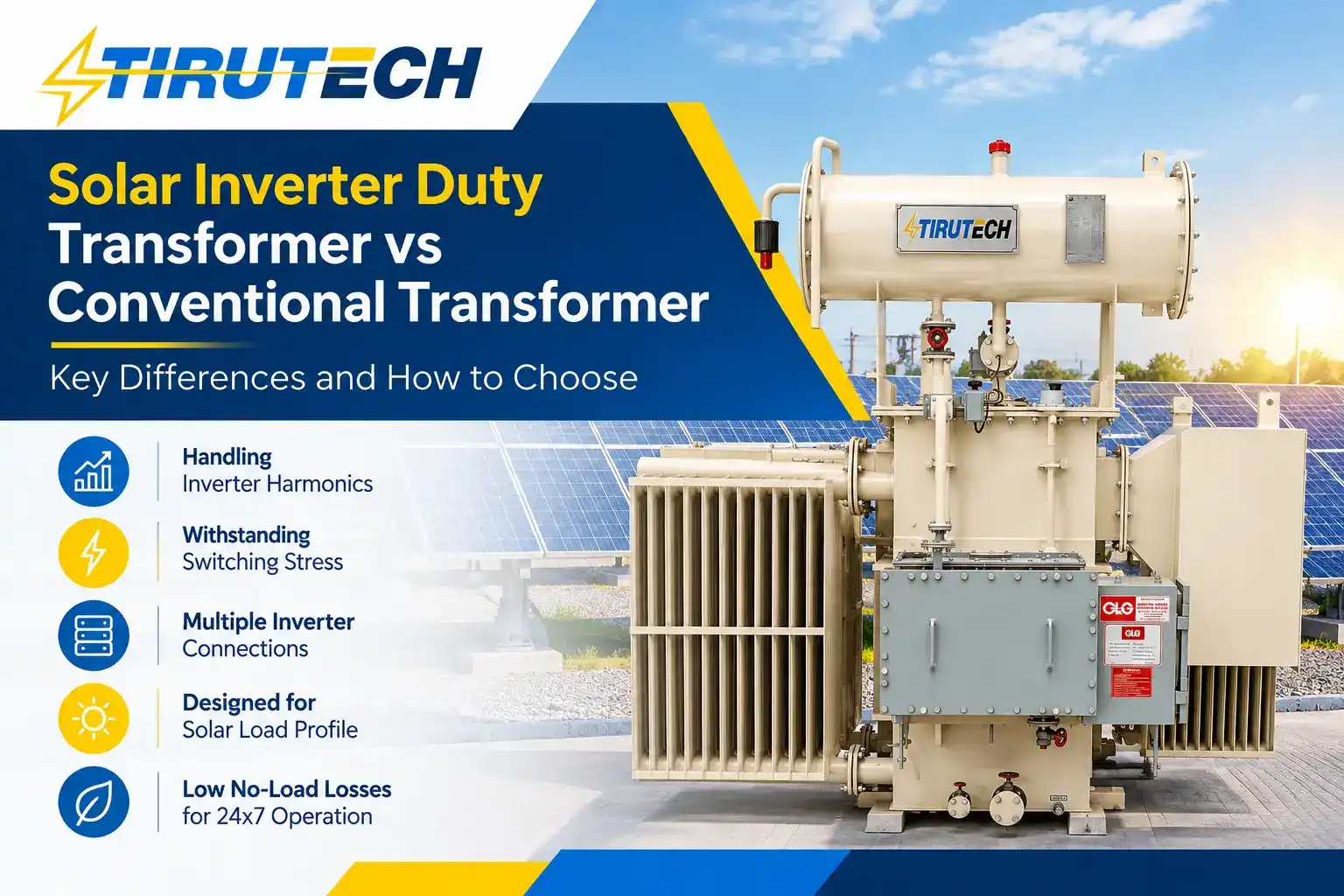
A solar inverter duty transformer is a transformer that steps up the low-voltage AC output of solar inverters to the medium voltage of the grid, such as 11 kV, 22 kV or 33 kV. It sits between the inverters and the evacuation line or substation.
In a utility-scale or captive solar plant, several inverters often feed one transformer. For this reason, many IDTs are built with two or more low-voltage windings, one for each inverter or group of inverters, and a single high-voltage winding towards the grid.
Why a Conventional Transformer Is Not Enough for Solar
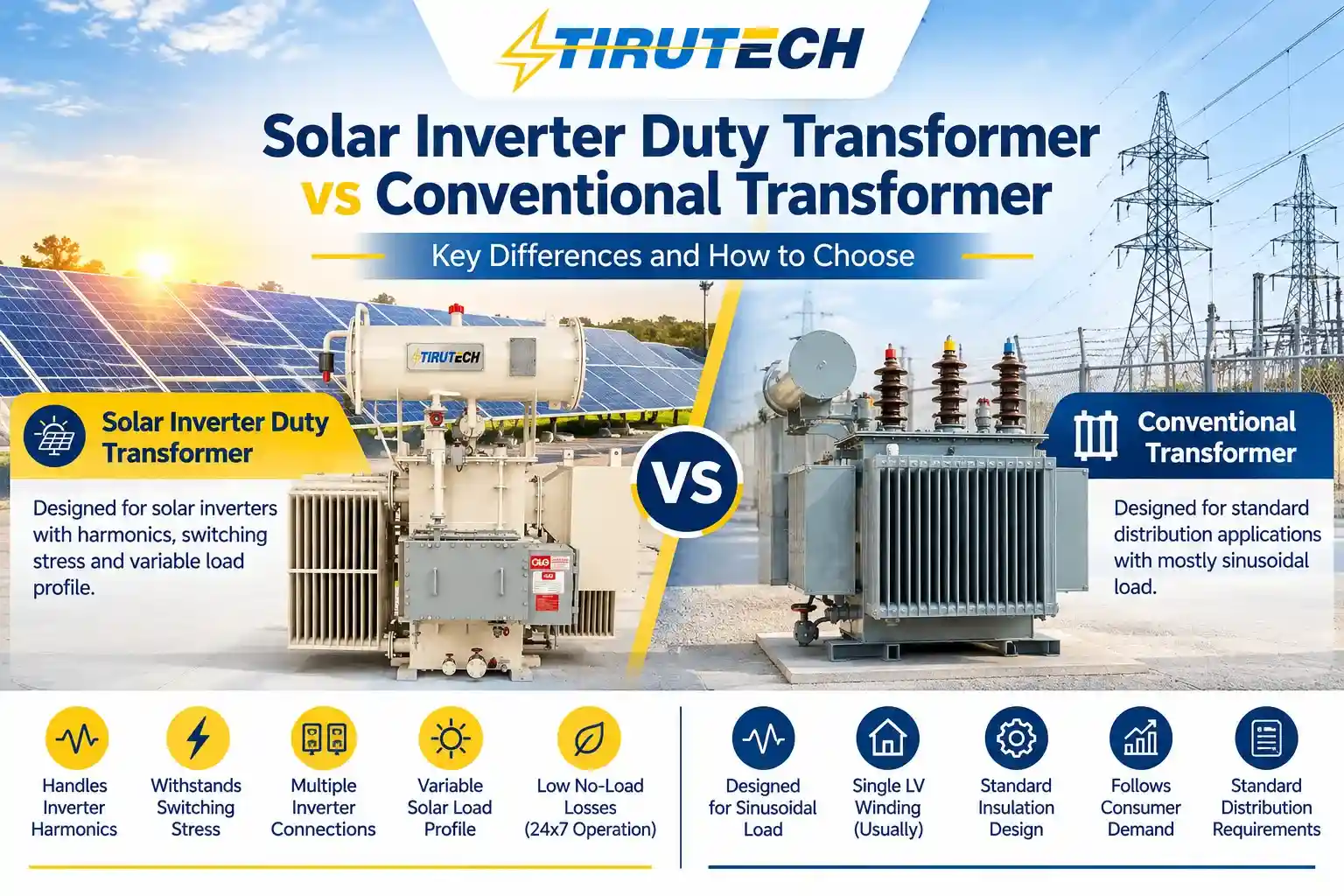
A conventional distribution transformer is designed to step voltage down from the grid to consumers, with a mostly sinusoidal load that follows demand. A solar plant behaves very differently, which is why the solar inverter duty transformer vs conventional transformer choice matters:
- Harmonics: inverters inject harmonic currents that cause extra heating in the windings and core
- Switching stress: fast inverter switching creates high voltage rise rates that stress the insulation
- Multiple inverters: several inverters may be connected to one transformer, so the winding arrangement must keep them electrically coordinated
- Load profile: the transformer is loaded during daylight hours and sits lightly loaded or idle at night, yet it remains energised
- Power flow: energy flows from the plant to the grid, the opposite of a normal distribution transformer
Solar Inverter Duty Transformer vs Conventional Transformer: Key Differences
| Parameter | Inverter Duty Transformer (IDT) | Conventional Distribution Transformer |
|---|---|---|
| Main function | Step-up from inverter output to medium voltage | Step-down from grid to consumer |
| Power flow | From solar plant to grid | From grid to load |
| Load profile | Follows sunlight, low or no load at night | Follows consumer demand |
| Harmonics | Designed for inverter harmonic currents | Usually designed for a sinusoidal load |
| Windings | Often two or more LV windings for several inverters | Typically one LV winding |
| Insulation stress | Designed for fast switching, often with an electrostatic shield between windings | Standard insulation design |
| No-load loss | Very important, as the unit is energised all day and night | Important, but load is usually continuous |
| Typical voltage | Inverter side about 0.4 to 0.69 kV; HV side 11, 22 or 33 kV | 11 or 33 kV to 0.433 kV |
| Design inputs | Inverter data, harmonic spectrum, fault level, plant layout | Load and standard distribution requirements |
Values in this solar inverter duty transformer vs conventional transformer table are typical. Always follow the project specification and the inverter manufacturer’s requirements.
Where Are Inverter Duty Transformers Used?
- Utility-scale solar power plants
- Captive solar plants of factories and industrial parks
- Commercial and industrial rooftop systems that connect at medium voltage
- Hybrid plants combining solar with wind or storage, subject to project design
Our range also includes compact substations and turnkey projects for such installations. See our solar inverter duty transformers for the available range.
Key Specifications to Check Before You Order
Use this checklist when preparing your enquiry or reviewing a quotation:
- MVA rating: matched to the total AC output of the connected inverters
- Voltages: inverter-side voltage and the HV level, such as 11, 22 or 33 kV
- Number of LV windings: one per inverter or per inverter group, as per your design
- Vector group: commonly selected as per the inverter manufacturer and project requirement
- Impedance: coordinated with the grid fault level and the inverter current limits
- Harmonic capability: the design must account for the inverter’s harmonic spectrum
- Electrostatic shield and insulation level: to withstand switching and transient stress
- Losses: compare the guaranteed no-load and load losses, as no-load loss runs every hour of the year
- Cooling and sealing: ONAN is common, and sealed designs suit dusty outdoor sites
- Temperature rise and ambient conditions: especially for hot regions with high ambient temperature
- Accessories and protection: temperature indicators, pressure relief device and other items as per the specification
- Guaranteed technical particulars (GTP): review every line before approving the design
Explore our solar inverter duty transformer solutions and contact our team to discuss your project requirements.
Example: Sizing an Inverter Duty Transformer
This illustrative example applies the solar inverter duty transformer vs conventional transformer logic to a sizing case. Consider a 2.5 MW AC solar plant that uses two 1,250 kVA inverters connected at 690 V. The plant needs an IDT with two LV windings of 1,250 kVA each, a total rating of 2,500 kVA, 690 V on the LV side and 33 kV (or 11 kV) on the HV side.
Before finalising, confirm the rating against the inverter’s maximum AC output, including its reactive power capability. For a general method on ratings and tap changers, read our guide on how to select a power transformer.
Standards and Compliance Checklist for India
- IS 2026: the Indian standard series for power transformers, available through the Bureau of Indian Standards
- IEC 60076 series: the international standard family for power transformers, published by the International Electrotechnical Commission
- IEEE C57.159: a guide covering transformers used in distributed photovoltaic systems, described on the ANSI blog
- Grid and utility requirements: check the technical guidance of the Central Electricity Authority and your utility
- Project and policy context: refer to the Ministry of New and Renewable Energy for the latest solar guidelines
- Test reports: ask for routine test reports for every unit and the type test reports applicable to the design
Tirupati Transformers works under a BIS licence (IS 1180 / IS 2026) and is ISO 9001:2015 certified, with NSIC and ERDA credentials.
Common Mistakes When Selecting a Solar Transformer
- Using a standard distribution transformer without checking inverter harmonics and switching stress
- Ignoring no-load loss, even though the unit is energised around the clock
- Choosing the MVA rating without confirming the inverter’s maximum AC output
- Mismatching the number of LV windings with the inverter grouping
- Approving a quotation without reviewing the GTP
- Forgetting site conditions such as high ambient temperature and dust
Why Buyers Choose Tirupati Transformers
Tirupati Transformers Pvt. Ltd. has been manufacturing transformers since 2014 from Greater Noida, NCR. Our range covers power transformers, distribution transformers, cast resin / dry type transformers, solar inverter duty transformers, VOPI transformers, compact substations, servo voltage stabilizers and turnkey projects, with ratings from 100 kVA to 10 MVA up to 33 kV.
We supply industrial clients across Noida, Ghaziabad, Gurgaon and Faridabad and export to more than 20 countries in Africa and the Middle East. If you are looking for a transformer manufacturer in Greater Noida for your solar project, our engineers can review your inverter data and recommend the right design. You can also explore our power transformers and distribution transformers.
Get a recommendation: Share your inverter make and model, AC capacity, voltage level and site location. Call +91-9810995042 or email info@tirupatitransformer.com to request a quote.
Frequently Asked Questions
Solar Inverter Duty Transformer vs Conventional Transformer: What Is the Main Difference?
In the solar inverter duty transformer vs conventional transformer comparison, the main difference is the application. An IDT steps up inverter output to the grid and is built for harmonics, switching stress and multiple inverter inputs, while a conventional transformer steps voltage down for a grid-fed consumer load.
What is a solar inverter duty transformer?
A solar inverter duty transformer is a step-up transformer that connects solar inverters to the medium-voltage grid. It is designed for inverter harmonics, switching stress, multiple inverter inputs and a load that follows sunlight.
Can a normal distribution transformer be used in a solar plant?
It is not recommended for inverter-connected solar generation unless its design has been checked against the inverter harmonics, switching stress and loading pattern. Always confirm with the inverter manufacturer and review the transformer GTP before using a conventional unit.
Why do solar transformers have more than one LV winding?
Multiple LV windings let several inverters connect to a single transformer while staying electrically separate. This reduces the number of transformers needed and can lower the project cost, as long as the winding arrangement matches the inverter design.
Why is no-load loss important in a solar transformer?
The transformer remains energised day and night, but it delivers power only in daylight hours. The no-load loss therefore runs continuously and becomes a large share of the yearly energy loss, so a low-loss design saves money over the plant’s life.
What voltage does a solar inverter duty transformer use?
The inverter side is typically a low voltage such as 0.4 to 0.69 kV, while the HV side is usually 11, 22 or 33 kV depending on the evacuation line. The exact values depend on your inverter and grid connection.
What transformer ratings does Tirupati Transformers manufacture?
Our overall range spans 100 kVA to 10 MVA up to 33 kV across power, distribution, cast resin / dry type and solar inverter duty transformers. Share your inverter and project details and we will confirm the exact rating and winding arrangement.
Conclusion
The solar inverter duty transformer vs conventional transformer choice is clear for solar plants: an IDT is designed for the demands of an inverter-connected plant, while a conventional transformer is designed for a grid-fed consumer load. Specify an IDT, match the rating and windings to your inverters, compare guaranteed losses and review the GTP before ordering. If you need help, send us your inverter details and we will suggest the right design.
Request a Solar Transformer Quotation
Share your inverter make and model, AC capacity, LV/HV voltage and project location with Tirupati Transformers.
