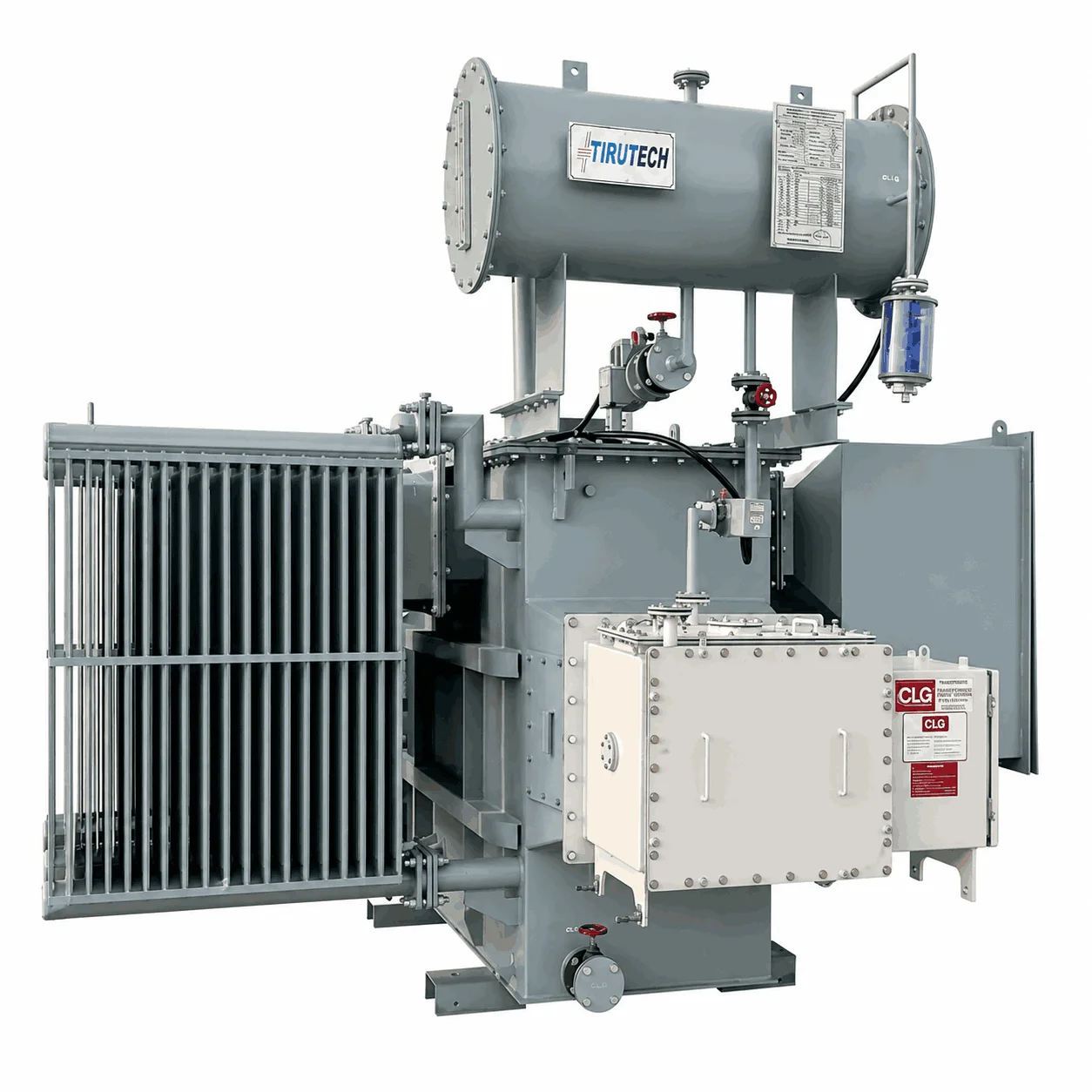
Distribution Transformer Manufacturer in India – 100 kVA to 5000 kVA
Tirupati Transformer is a transformer manufacturing company based in Greater Noida, Uttar Pradesh, serving customers across Delhi NCR and other parts of India. We manufacture and supply Distribution Transformer solutions for industrial, commercial, infrastructure, utility, renewable energy and institutional applications.
Our distribution transformers are engineered according to the required electrical specifications, installation conditions, loading requirements and applicable standards. Depending on the application, customers can specify voltage ratio, kVA rating, vector group, impedance, tapping arrangement, cooling method, winding material and other design parameters.
From standard distribution transformer requirements to application-specific transformer solutions, our focus is on reliable electrical performance, controlled manufacturing, testing and proper technical documentation.
Looking for a Distribution Transformer Manufacturer in India? Contact Tirupati Transformer for technical consultation and a quotation based on your project requirements.
What Is a Distribution Transformer?
Quick Answer: A distribution transformer is an electrical device that steps down high voltage (11kV or 33kV) from the power grid to safe, usable voltage (433V three-phase or 230V single-phase) at the consumer end — making it the final and most critical link in India’s power delivery chain.
Based in Greater Noida, we also supply distribution transformers in Delhi NCR with fast local delivery, factory inspection before dispatch and on-site support.
For example, a transformer can step down an 11 kV supply to a low-voltage distribution level such as 433 V, depending on the system design and project requirements.
Distribution transformers are commonly installed near electrical loads to provide an efficient and reliable supply to:
- Industrial facilities
- Commercial buildings
- Residential developments
- Manufacturing plants
- Infrastructure projects
- Educational institutions
- Hospitals
- Renewable energy installations
- Utility distribution networks
- Commercial and industrial electrical systems
The correct transformer rating depends on connected load, demand factor, future expansion, voltage level, operating environment and required performance.
Distribution Transformer Manufacturer in India
Choosing the right Distribution Transformer Manufacturer is important because transformer performance directly affects the reliability and efficiency of an electrical distribution system.
Tirupati Transformer provides transformer solutions designed around project-specific requirements. Our manufacturing approach covers core selection, winding, insulation, tank fabrication, assembly, accessories, testing and documentation.
We work with customers to understand:
- Required transformer capacity
- Primary and secondary voltage
- Frequency
- Vector group
- Percentage impedance
- Tap range
- Cooling arrangement
- Installation environment
- Indoor or outdoor application
- Winding material
- Protection and monitoring requirements
This engineering-based approach helps customers select a transformer suitable for their electrical system rather than choosing only on the basis of kVA rating.
Distribution Transformer Range
Tirupati Transformer can provide distribution transformer solutions across different ratings and configurations based on project requirements.
Typical Applications
- 11 kV distribution systems
- 33 kV distribution systems
- Industrial power distribution
- Commercial electrical distribution
- Solar and renewable energy projects
- Infrastructure projects
- Manufacturing units
- Utility and substation applications
- Construction and real-estate projects
For higher-capacity requirements, the transformer design and applicable standards should be evaluated according to the specific application and rating.
11 kV Distribution Transformer
An 11 kV Distribution Transformer is widely used for stepping down medium-voltage electrical supply to a lower distribution voltage.
A common configuration is:
11 kV / 433 V
However, the actual voltage ratio, vector group, impedance and tapping arrangement should be selected according to the electrical system and project specifications.
11 kV distribution transformers can be used in:
- Industrial plants
- Commercial complexes
- Residential projects
- Utility distribution
- Solar projects
- Infrastructure installations
- Manufacturing facilities
33 kV Distribution Transformer
For systems operating at higher distribution voltage levels, a 33 kV Distribution Transformer can be designed according to the required electrical specifications.
These transformers may be used in:
- Industrial distribution networks
- Large infrastructure projects
- Utility systems
- Renewable energy installations
- Substation applications
- Large commercial and industrial facilities
The transformer rating, insulation requirements, clearances, accessories and testing requirements should be finalized according to the project specification and applicable standards.
Oil Immersed Distribution Transformer
An Oil Immersed Distribution Transformer uses transformer oil for electrical insulation and heat transfer.
Oil-immersed transformers are commonly selected for outdoor electrical distribution applications because of their established design and cooling characteristics.
Depending on the design, features may include:
- CRGO steel core
- Copper or aluminium windings
- Mineral insulating oil or specified insulating fluid
- Radiator or corrugated tank construction
- Conservator arrangement where applicable
- Breather arrangement where applicable
- Off-circuit tap changer
- Temperature indicators
- Oil level indication
- Pressure relief arrangements
- HV and LV bushings
- Earthing provisions
The final configuration depends on the transformer design and customer requirements.
KVA RANGE & AVAILABLE RATINGS
We manufacture distribution transformers in the following standard KVA ratings. Custom ratings outside this range are also engineered on request:
| Category | Available KVA Ratings |
|---|
| Small Range | 100 kVA, 160 kVA, 200 kVA |
| Medium Range | 250 kVA, 315 kVA, 400 kVA, 500 kVA |
| Large Range | 630 kVA, 750 kVA, 1000 kVA, 1250 kVA |
| Extra Large | 1500 kVA, 2000 kVA, 2500 kVA, 3000 kVA |
| Heavy Duty | 4000 kVA, 5000 kVA |
💡 Need a non-standard rating? Our in-house design team can engineer custom distribution transformer units as per your exact load calculations, voltage ratio, and environmental specifications. Request Custom Engineering →
Distribution Transformer Construction
The performance of a transformer depends on the quality of its electrical and mechanical construction.
Transformer Core
The magnetic core is manufactured using suitable electrical-grade CRGO steel. Core design is optimized to control no-load losses, magnetizing current and overall transformer performance.
Transformer Windings
Windings may be manufactured using copper or aluminium conductors according to the required electrical and thermal design.
The winding design considers:
- Current density
- Insulation system
- Short-circuit strength
- Temperature rise
- Voltage level
- Mechanical strength
Insulation System
The insulation system is selected according to the voltage class, transformer design and operating conditions.
Proper insulation coordination is important for maintaining electrical reliability throughout the transformer service life.
Transformer Tank
The tank provides mechanical protection and contains the transformer core, windings and insulating medium in oil-immersed designs.
The tank design considers:
- Mechanical strength
- Oil containment
- Sealing
- Pressure conditions
- Corrosion protection
- Transportation requirements
Distribution Transformer Manufacturing Process
At Tirupati Transformer, transformer manufacturing involves multiple controlled stages.
1. Engineering & Design
The transformer is designed according to electrical specifications, capacity, voltage ratio, impedance, vector group, cooling arrangement and application.
2. Core Manufacturing
Electrical-grade CRGO laminations are processed and assembled according to the required core design.
3. Winding
HV and LV windings are manufactured according to the electrical and mechanical design.
| Parameter | Copper Winding | Aluminium Winding |
|---|
| Conductivity | Higher | Lower |
| Resistance | Lower | Higher |
| Efficiency | Better | Slightly lower |
| Weight | Heavier | Lighter |
| Life | Longer | Good |
| Cost | Higher | Lower |
| Best For | Industrial, DISCOM | Housing, budget projects |
4. Core-Coil Assembly
The core and winding assembly is completed with appropriate insulation and mechanical arrangements.
5. Tank Fabrication
The transformer tank and associated components are fabricated according to the required mechanical design.
6. Assembly
The transformer is assembled with bushings, tap changer, cooling components, accessories and other specified equipment.
7. Oil Processing
For oil-immersed transformers, the insulating oil and internal insulation system are processed according to the applicable manufacturing procedure.
8. Testing
The completed transformer undergoes applicable routine and/or type/special tests according to the project specification and relevant standards.
9. Final Inspection
Final inspection covers physical condition, accessories, nameplate details, dimensions, documentation and test results.
10. Dispatch
After completion of inspection and documentation, the transformer is prepared for safe transportation to the project location.
Distribution Transformer Testing
Testing is an essential part of transformer manufacturing because it helps verify electrical performance and construction quality.
Depending on the transformer design and applicable requirements, testing may include:
- Winding resistance test
- Insulation resistance test
- Voltage ratio test
- Polarity and phase-relation verification
- No-load loss and current measurement
- Load loss measurement
- Impedance measurement
- Applied voltage test
- Induced voltage test
- Oil-related tests where applicable
- Temperature-rise or other specified tests
- Type or special tests where required
Testing requirements should always be determined according to the applicable standard, transformer design and customer specification.
Distribution Transformer Efficiency and Losses
Transformer efficiency is an important consideration when selecting a distribution transformer because losses occur during both no-load and loaded operation.
The two major categories are:
No-load losses: These are primarily associated with the transformer core and occur whenever the transformer remains energized.
Load losses: These are mainly associated with winding resistance and other load-dependent effects and increase with transformer loading.
An appropriately designed Distribution Transformer Supplier in Delhi aims to achieve the required electrical performance while minimizing avoidable losses.
In India, Distribution Transformers are included in the Bureau of Energy Efficiency’s Standards & Labelling programme.
BIS and Applicable Standards for Distribution Transformers
Transformer standards depend on the transformer type, voltage, rating and intended application.
For outdoor oil-immersed distribution transformers, BIS 1180 (Part 1) is an important Indian Standard. The current BIS listing identifies the standard for outdoor oil-immersed distribution transformers up to and including 2,500 kVA and 33 kV.
For a specific project, the applicable BIS/IS requirements should be confirmed according to:
- Transformer rating
- Voltage class
- Transformer construction
- Installation
- Customer specification
- Utility/DISCOM requirements
- Applicable certification requirements
Tirupati Transformer manufactures transformers according to applicable technical specifications and standards relevant to the ordered product.
Distribution Transformer Applications
Distribution transformers are used across a wide range of industries and electrical systems.
Industrial Applications
Used in manufacturing plants, engineering industries, processing facilities, warehouses and other industrial installations.
Commercial Applications
Suitable for malls, offices, hotels, commercial buildings and large electrical installations.
Infrastructure Projects
Distribution transformers can be used for airports, metro-related infrastructure, institutional facilities and other infrastructure developments.
Renewable Energy
Transformers are an important part of solar inverter duty transformer and renewable energy electrical systems. The transformer design depends on the inverter, grid voltage and project configuration.
Utility Distribution
Distribution transformers are widely used in electrical distribution networks for supplying lower-voltage consumers.
How to Select the Right Distribution Transformer?
Before purchasing a distribution transformer, consider the following parameters:
1. Transformer Capacity
Select the kVA/MVA rating based on present load, demand and expected future expansion.
2. Primary Voltage
Specify whether the system requires 11 kV, 22 kV, 33 kV or another voltage level.
3. Secondary Voltage
The secondary voltage should match the requirements of the connected electrical system.
4. Vector Group
The appropriate vector group should be selected according to the system configuration and protection requirements.
5. Impedance
Percentage impedance affects voltage regulation and fault-current characteristics.
6. Tapping Arrangement
Off-circuit or on-load tap-changing arrangements can be considered depending on the application.
7. Installation Environment
Outdoor, indoor, high-temperature, dusty, humid, coastal and other environments may require different design considerations.
8. Efficiency and Losses
Evaluate no-load and load losses rather than comparing transformers only on purchase price.
9. Testing and Documentation
Ensure that the supplier provides the required test reports, drawings, nameplate details and other project documentation.
Distribution Transformer Price in India
The Distribution Transformer Price in India depends on several factors, so a single fixed price cannot accurately represent every transformer.
Important cost factors include:
- Transformer capacity
- Voltage ratio
- Copper or aluminium winding
- Core material
- Loss requirements
- Oil and insulation system
- Tap changer
- Tank construction
- Accessories
- Testing requirements
- Certification requirements
- Transportation
- Project-specific specifications
For an accurate quotation, customers should provide the required kVA rating, voltage ratio, vector group, frequency, tapping range and application details.
Contact Tirupati Transformer for a project-specific Distribution Transformer quotation.
Why Choose Tirupati Transformer?
Tirupati Transformer focuses on engineering, manufacturing, testing and supply of transformer solutions for industrial and commercial applications.
Engineering-Based Manufacturing
Transformers are designed around the required electrical and application parameters.
Quality-Focused Manufacturing
Material selection, core and winding construction, assembly and testing are important stages of our manufacturing process.
Customized Transformer Solutions
Customers can specify requirements such as rating, voltage ratio, vector group, impedance, tapping arrangement and cooling method.
Testing & Documentation
Applicable testing and documentation can be provided according to the transformer specification and project requirements.
Delhi NCR Manufacturing Location
Our manufacturing facility is located in Greater Noida, Uttar Pradesh, making us accessible to customers across Delhi NCR and North India.
Trustworthiness — Transparent, Accountable, Supported
- Complete Routine Test Certificate provided with every unit
- Factory inspection invited before dispatch — clients can visit our Greater Noida facility
- After-sales support team available post-installation
- Standard warranty on all units
- 24-hour quote turnaround — no hidden pricing
- Dedicated sales engineer assigned to every project
We purchased a 1250 kVA distribution transformer and were impressed with the timely delivery and after-sale service. — Mr. Pramod Kumar, Client
The product quality is good with a reasonable price. I purchased a 1000 kVA transformer last month. — Mr. Rajeev Wadhwa, Client
Distribution Transformer Manufacturer in Greater Noida
Tirupati Transformer is based in Greater Noida, Uttar Pradesh, and serves customers looking for transformer manufacturing and supply solutions in Delhi NCR.
Our location allows us to serve projects in:
- Greater Noida
- Noida
- Delhi
- Ghaziabad
- Faridabad
- Gurugram
- Uttar Pradesh
- Haryana
- Rajasthan
- Punjab
- Delhi NCR and other parts of India
For projects outside Delhi NCR, transportation and delivery requirements can be planned according to transformer dimensions, weight, site conditions and project schedule.
STATES & CITIES WE SERVE
Tirupati Transformer supplies distribution transformers Pan-India with fast dispatch from our Greater Noida manufacturing facility:
North India: Delhi NCR | Greater Noida | Noida | Gurgaon | Faridabad | Ghaziabad | Lucknow | Kanpur | Agra | Varanasi | Meerut | Jaipur | Jodhpur | Chandigarh | Ludhiana | Amritsar | Dehradun
West India: Mumbai | Pune | Ahmedabad | Surat | Vadodara | Nagpur | Nashik | Indore | Bhopal
South India: Hyderabad | Bengaluru | Chennai | Coimbatore | Visakhapatnam
East India: Kolkata | Patna | Bhubaneswar | Ranchi
Export Markets: Kenya | Saudi Arabia | UAE | Qatar | Tanzania | Nigeria | Nepal | Bangladesh | Sri Lanka
Frequently Asked Questions About Distribution Transformer
Q1. What is a Distribution Transformer?
A Distribution Transformer is an electrical transformer used to step down medium-voltage electricity to a lower voltage suitable for distribution and end-use applications.
Q2. What is a common 11 kV Distribution Transformer voltage ratio?
One commonly used configuration is 11 kV / 433 V. However, the required voltage ratio depends on the electrical distribution system and project specification.
Q3. What is the difference between a Power Transformer and a Distribution Transformer?
Power Transformers are generally used for higher-voltage transmission and substation applications, while distribution transformers are primarily used closer to consumers to step down electrical voltage for distribution.
Q4. Which transformer is better: copper or aluminium winding?
Both copper and aluminium can be used in transformer windings. The appropriate conductor depends on the electrical design, losses, thermal requirements, mechanical strength and project specifications.
Q5. What affects Distribution Transformer price?
Capacity, voltage ratio, winding material, core material, losses, accessories, tap changer, testing, specifications and transportation can all affect the final price.
Q6. How can I choose the right Distribution Transformer?
Start with the required kVA rating, primary and secondary voltage, vector group, impedance, tapping requirements, installation environment and load profile. A transformer manufacturer can then finalize the design.
Q7. Does a Distribution Transformer require maintenance?
Yes. Maintenance requirements depend on the transformer construction. Oil-immersed transformers require appropriate inspection and maintenance of oil, bushings, connections, protection devices and other components according to the manufacturer’s recommendations.
Q8. What is the standard delivery time for a distribution transformer?
Standard rated distribution transformer units (100 kVA to 1000 kVA) are typically dispatched within 3–4 weeks from order confirmation and advance payment. Larger ratings (1250 kVA to 5000 kVA) or custom-engineered units require 5–8 weeks. Urgent project requirements can be prioritised — contact our sales team directly at +91-9810995042.
Q9. Can Tirupati Transformer manufacture customized transformers?
Yes. Transformer specifications can be developed according to customer requirements, subject to technical feasibility and applicable standards.
Q10. Where is Tirupati Transformer located?
Tirupati Transformer is located in Greater Noida, Uttar Pradesh, and serves customers across Delhi NCR and other parts of India.
Q11. Are Tirupati Transformers DISCOM approved?
Yes, Tirupati Transformer units are listed on various State DISCOM approved vendor lists. Please contact us for your state-specific requirement.
Q12. Which standards do Tirupati distribution transformers follow?
Our distribution transformers are manufactured as per IS 1180, under ISO 9001:2015 certified quality systems and a BIS licence.
Get a Distribution Transformer Quotation
Looking for a reliable Distribution Transformer Manufacturer in Delhi NCR or India?
Share your transformer requirements with Tirupati Transformer, including:
- Required capacity
- Primary voltage
- Secondary voltage
- Frequency
- Vector group
- Tap range
- Impedance
- Winding material
- Installation location
- Quantity
- Required delivery schedule
Our team can review your requirements and provide a suitable technical and commercial proposal.
GET A FREE QUOTE → CALL NOW → WHATSAPP NOW →