 Sushil Singh 7 February 2026
⚡ Quick Answer — How to Select a Power Transformer:
To select the right Power Transformer, evaluate: (1) required HV/LV voltage ratio, (2) MVA/kVA capacity based on actual maximum demand, (3) load characteristics including harmonics, (4) cooling arrangement — ONAN or ONAF, (5) tap-changer type — OLTC or OCTC, (6) applicable standard (IS 2026 / IEC 60076), and (7) manufacturer capability and after-sales support. Total cost of ownership matters more than purchase price alone.
Knowing How to Select a Power Transformer correctly is one of the most important engineering decisions for industrial plants, grid substations, captive power projects, solar installations and infrastructure developments. An incorrectly specified transformer can cause overheating, voltage regulation problems, excessive energy losses and costly downtime.
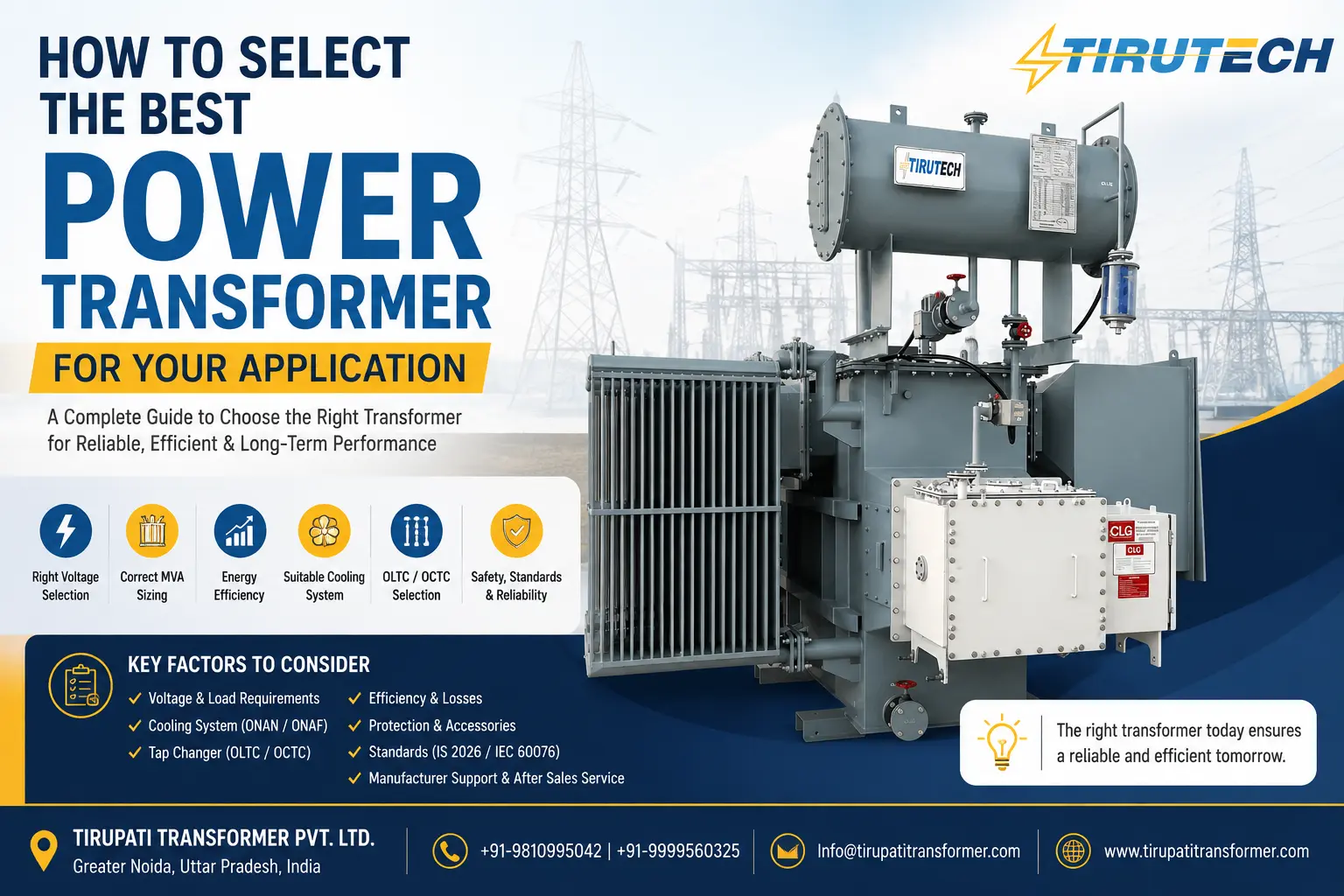
This guide — prepared by the engineering team at Tirupati Transformer Pvt. Ltd., an ISO 9001:2015 certified transformer manufacturer in Greater Noida — explains every key factor to evaluate before purchasing a Power Transformer.
What Is a Power Transformer?
A Power Transformer is a static electrical device that transfers electrical energy between two circuits through electromagnetic induction while changing the voltage level. Power Transformers are designed for high-voltage, high-capacity applications, typically above 500 kVA. Tirupati Transformer manufactures Power Transformers up to 10 MVA with voltage levels up to 33 kV — for higher requirements beyond this range, our engineering team can advise on suitable alternatives.
Power Transformers are used in:
- Power generation plants and grid substations
- Industrial electrical systems (steel, cement, chemicals, pharma)
- Captive power projects and co-generation plants
- Solar, wind and hybrid renewable energy installations
- Infrastructure projects — metro, airports, data centres
- EPC and turnkey electrical projects
Power Transformer vs Distribution Transformer: Power Transformers are generally rated above 500 kVA and used at the transmission/primary distribution level. Distribution Transformers step voltage down to the end-user level. See our Distribution Transformer range for lower-voltage, secondary distribution requirements.
How to Select a Power Transformer — 12 Key Factors
Selecting a Power Transformer is more than choosing a kVA/MVA capacity. The transformer should match the complete electrical, environmental and operational requirements of your project. Below are the 12 essential factors every buyer and engineer should evaluate.
1. Assess Voltage Requirements
Understanding How to Select a Power Transformer begins with defining the correct HV and LV voltage levels for your system.
- Define HV and LV voltage levels
- Confirm system frequency (50 Hz in India)
- Identify required tap range
- Check voltage regulation requirements against your single-line diagram
A step-up transformer raises voltage (e.g., generator to grid), while a step-down transformer reduces voltage (e.g., incoming utility supply to plant distribution). The voltage configuration must match your electrical system design.
2. Determine the Required MVA / kVA Rating
Power Transformer capacity is expressed in kVA or MVA. Do not simply add nameplate ratings of all connected equipment — this often leads to oversizing. Instead, calculate the actual maximum demand.
Key considerations for Power Transformer sizing:
- Present and expected maximum demand
- Load diversity and operating profile
- Motor starting requirements
- Continuous vs. intermittent loading
- Ambient temperature at site
- Planned future plant expansion
Tip: An undersized transformer overheats and fails prematurely. An oversized transformer operates inefficiently at low loads and increases capital cost unnecessarily. Always size based on actual maximum demand plus a reasonable future margin.
3. Evaluate Load Characteristics
The type of electrical load directly influences transformer design. Industrial facilities often operate loads that introduce harmonics and voltage fluctuations — for example:
- Variable frequency drives (VFDs)
- Arc furnaces and induction furnaces
- Rectifiers and power-electronic equipment
- Large motors with high starting currents
- Solar inverters (non-sinusoidal output)
- Welding equipment
Non-linear and harmonic-producing loads can affect transformer temperature, insulation stress and losses. Share load details with your transformer manufacturer before finalising the design.
4. Prioritise Energy Efficiency and Transformer Losses
Power Transformers often run continuously, so transformer losses directly impact your electricity costs over the equipment’s operating life.
| Loss Type | Description |
|---|---|
| No-Load Losses (Core Losses) | Occur whenever the transformer is energised, even at zero load |
| Load Losses (Copper Losses) | Vary with load current; influenced by winding resistance and design |
| Total Owning Cost | Capitalised losses over transformer life should be compared, not only purchase price |
BEE (Bureau of Energy Efficiency) has established efficiency norms for transformers in India. For Power Transformers, evaluate guaranteed losses from the manufacturer and apply a total cost of ownership calculation before comparing quotations.
External reference: Bureau of Energy Efficiency, India (BEE)
5. Select the Appropriate Cooling System
Transformer losses generate heat during operation. The cooling system must dissipate this heat to maintain transformer temperature within design limits.
| Cooling Code | Full Form | Suitable For |
|---|---|---|
| ONAN | Oil Natural Air Natural | Standard applications; natural oil and air circulation |
| ONAF | Oil Natural Air Forced | Higher ratings; forced-air fans on radiators |
| OFAF | Oil Forced Air Forced | Large transformers; forced oil and air circulation |
Cooling selection depends on MVA rating, load profile, site ambient temperature and installation conditions. Discuss site-specific parameters with the manufacturer.
6. Choose Between OLTC and OCTC
Tap changers allow adjustment of the transformer voltage ratio to manage voltage variations.
- OLTC (On-Load Tap Changer) — tap changes while transformer is energised; suitable for systems requiring continuous voltage regulation. Often specified with an RTCC panel and Automatic Voltage Regulator (AVR).
- OCTC (Off-Circuit Tap Changer) — adjusted when transformer is de-energised; suitable where periodic adjustment is sufficient.
The choice between OLTC vs OCTC depends on voltage variation at the supply point, grid conditions, system sensitivity and the project specification.
7. Specify Protection and Monitoring Equipment
Appropriate protection ensures transformer safety and operational continuity. Common accessories include:
- Oil Temperature Indicator (OTI) and Winding Temperature Indicator (WTI)
- Magnetic Oil Level Gauge (MOG)
- Pressure Relief Device (PRD)
- Buchholz Relay (for sealed and conservator type)
- Dehydrating Breather
- Marshalling Box
- Current Transformers (for metering and protection)
- RTCC Panel and AVR (for OLTC applications)
Protection requirements should be finalised in accordance with the project’s electrical protection philosophy and relay coordination study.
8. Verify Applicable Standards and Certifications
Confirm the standards applicable to your project before inviting quotations.
- IS 2026 — Indian Standard for Power Transformers (Bureau of Indian Standards)
- IEC 60076 — International Electrotechnical Commission standard for Power Transformers
- BIS licence requirements for applicable ratings
- Utility-specific or EPC specifications
External references: Bureau of Indian Standards (BIS) | International Electrotechnical Commission (IEC)
Always request applicable test reports and certification documents — do not rely only on what is listed on a supplier’s website.
9. Review Testing Requirements
Transformer testing validates that the manufactured unit meets the specified performance. Routine tests typically include:
- Winding resistance measurement
- Voltage ratio and polarity
- Vector group verification
- Impedance and load losses
- No-load losses and no-load current
- Separate-source AC withstand test
- Induced overvoltage withstand test
- Transformer oil dielectric testing
- Tap changer and accessory checks
For EPC and utility projects, customers may specify type tests, special tests and third-party inspection. Confirm the testing scope before placing an order.
10. Evaluate the Power Transformer Manufacturer
The manufacturer’s capability is as important as the transformer specification itself. Before finalising a supplier, assess:
- Manufacturing experience with the required rating and type
- Technical capability to configure the required design
- Quality systems — ISO certification, BIS licence
- Documentation — datasheet, GA drawing, schematic, guaranteed losses, test reports
- After-sales support — warranty, commissioning assistance, spare parts, service response
11. Consider Installation and Site Conditions
- Indoor or outdoor installation
- Ambient temperature and altitude
- Humidity, dust, pollution level
- Available space and foundation
- Transportation route and access
- Fire-safety requirements
- Ventilation requirements for indoor installations
12. Compare Total Cost of Ownership
The lowest purchase price is not necessarily the lowest-cost transformer over its operating life.
Total Cost = Purchase Price + Capitalised Losses + Maintenance + Downtime Risk + Spare Parts + Service + Transportation + Installation
A higher-efficiency transformer with guaranteed lower losses can offer better value over 25–30 years of operation, even if the initial cost is higher.
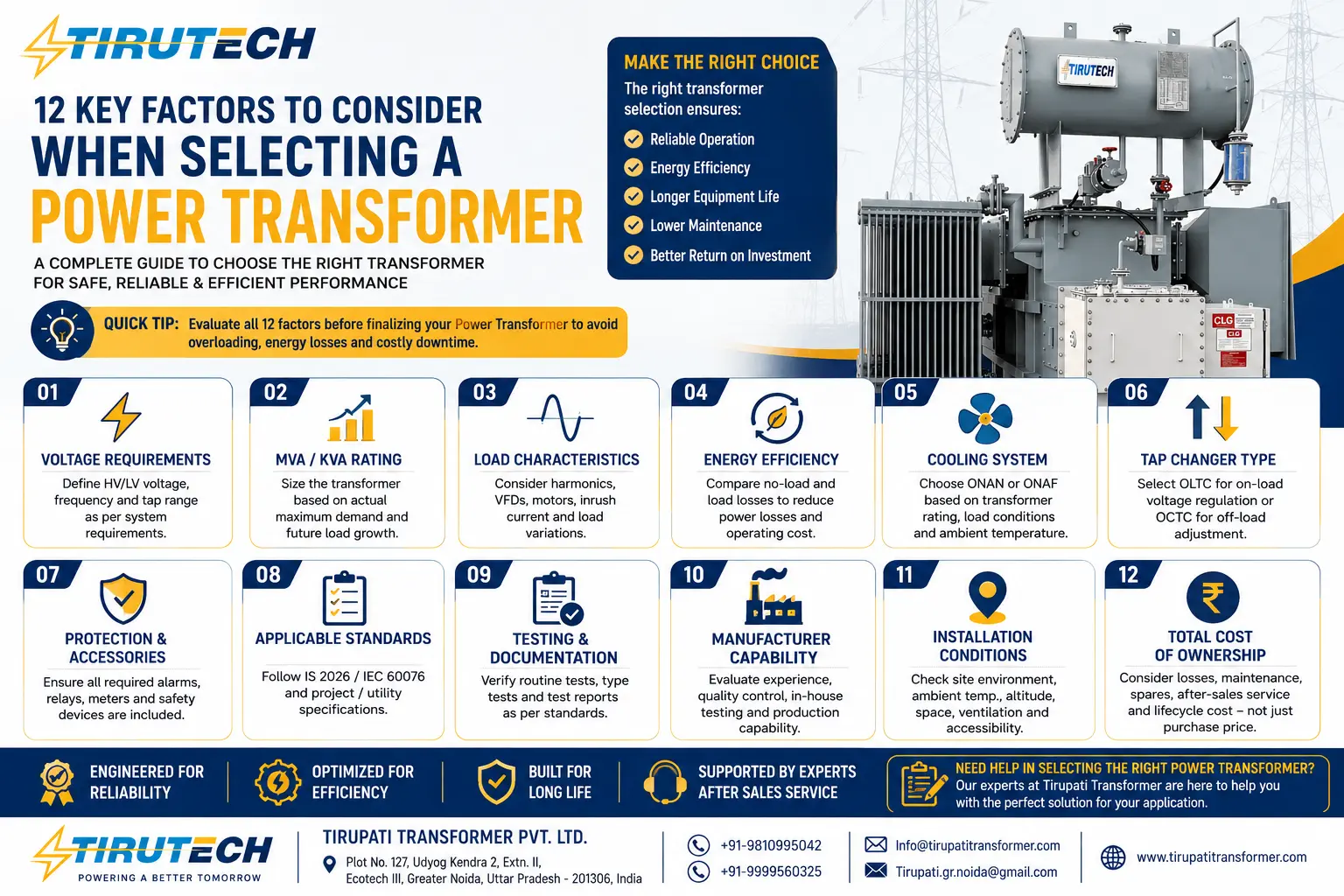
Power Transformer Selection Checklist
| Parameter | What to Confirm |
|---|---|
| MVA / kVA Rating | Based on actual maximum demand + future growth margin |
| HV Voltage | Required primary / high-voltage level |
| LV Voltage | Required secondary / low-voltage level |
| Frequency | 50 Hz (India standard) |
| Vector Group | As per electrical system requirement (e.g. Dyn11) |
| Impedance | Per project short-circuit and protection study |
| Cooling | ONAN / ONAF / OFAF as required |
| Tap Changer | OLTC or OCTC — based on voltage regulation need |
| Protection Accessories | OTI, WTI, MOG, PRD, Buchholz, RTCC/AVR as needed |
| Losses | Guaranteed no-load and load losses from manufacturer |
| Standard | IS 2026 / IEC 60076 / project specification |
| Testing | Routine tests + any special or type tests required |
| Site Conditions | Ambient temperature, altitude, indoor/outdoor, pollution |
| Documentation | Datasheet, GA drawing, schematic, test reports |
| Warranty & Service | Warranty period, spare parts availability, commissioning support |
Common Mistakes When Selecting a Power Transformer
❌ Selecting capacity based on connected load only
Connected load ≠ maximum demand. Load diversity, operating hours and future expansion must all be factored in.
❌ Choosing the lowest-quoted price
Lower purchase cost can mean higher losses, reduced reliability and higher lifetime operating cost.
❌ Ignoring transformer losses
No-load and load losses accumulate over years. Even a 0.1% efficiency difference can represent significant cost over a 25-30 year asset life.
❌ Wrong cooling arrangement
Underspecified cooling leads to excessive temperature rise and reduced transformer life. Always specify cooling based on site ambient and actual load profile.
❌ Not reviewing technical documentation
Always verify the manufacturer’s technical datasheet, guaranteed losses, test reports and applicable certifications before order placement.
❌ Not accounting for future expansion
If the plant or facility is expected to expand within the transformer’s life, the sizing study should include that planned demand.
Power Transformer Selection for Solar and Renewable Energy Projects
Understanding How to Select a Power Transformer for solar projects is different from standard industrial selection — inverter harmonics and grid requirements must be specifically evaluated.
Key considerations for solar Power Transformer selection:
- Transformer MVA rating matched to inverter output
- Voltage ratio from inverter LV output to grid HV connection
- Harmonic content — k-factor or harmonic-rated design
- Cooling suitable for ambient temperatures at solar plant sites
- Grid connection requirements and utility specifications
- Protection and monitoring per project specification
Tirupati Transformer manufactures Solar Inverter Duty Transformers designed for solar and renewable energy applications — configured for inverter-connected service and outdoor site conditions.
Power Transformer Selection for Industrial Plants
How to Select a Power Transformer for industrial plants depends heavily on the plant’s load profile, harmonic content and future expansion plans.
| Industry | Key Transformer Requirement |
|---|---|
| Steel / Metals | High harmonic loads from arc furnaces; high fault level |
| Cement / Mining | High motor starting currents; continuous heavy load |
| Chemicals / Pharma | Sensitive loads; low-voltage fluctuation requirement |
| Data Centres | Continuous critical load; N+1 redundancy |
| Infrastructure / Metro | Traction loads; specific impedance requirements |
| Manufacturing | VFDs, motors; mixed linear and non-linear loads |
Share your plant’s load list, maximum demand and operating profile with Tirupati Transformer’s engineering team for a project-specific recommendation.
Why Choose Tirupati Transformer for Your Power Transformer Requirement?
Tirupati Transformer Pvt. Ltd. is an ISO 9001:2015 certified transformer manufacturer based in Greater Noida, Uttar Pradesh — serving industrial, utility, renewable energy and infrastructure customers across India and international markets since 2014.
| Capability | Details |
|---|---|
| Certification | ISO 9001:2015 | BIS Licensed Manufacturer |
| Manufacturing Location | Greater Noida, Delhi NCR, Uttar Pradesh |
| Products | Power Transformers, Distribution Transformers, Solar Inverter Duty Transformers, Cast Resin Transformers, Servo Voltage Stabilizers |
| Applicable Standards | IS 2026, IEC 60076 |
| Export Markets | 20+ countries served |
| Configuration | Project-specific MVA, voltage, cooling, OLTC/OCTC, protection |
| After-Sales | Commissioning support, spare parts, service |
Explore our transformer product range:
- Power Transformer
- Distribution Transformer
- Solar Inverter Duty Transformer
- Cast Resin Dry Type Transformer
- Servo Voltage Stabilizer
About the Author — Tirupati Transformer Engineering Team
This guide has been prepared by the engineering and technical team at Tirupati Transformer Pvt. Ltd., drawing on over a decade of experience in manufacturing Power Transformers and Distribution Transformers for industrial, utility and renewable energy applications across India and international markets. Tirupati Transformer is ISO 9001:2015 certified and BIS licensed, with a manufacturing facility in Greater Noida, Uttar Pradesh.
Frequently Asked Questions — Power Transformer Selection
Q1. What is the most important factor when selecting a Power Transformer?
Ans: The most critical factors are the required MVA rating (based on actual maximum demand), HV/LV voltage levels, load characteristics, cooling arrangement, tap-changer type and applicable project standards. All these must be evaluated together — no single factor alone determines the right transformer.
Q2. How do I calculate the Power Transformer capacity (kVA/MVA) required?
Ans: Calculate the plant’s actual maximum demand from the connected load list, applying a load diversity factor. Add a margin for future expansion. For large projects, transformer sizing should be confirmed by the project’s electrical engineer using a load flow study.
Q3. What is the difference between ONAN and ONAF cooling?
Ans: ONAN (Oil Natural Air Natural) uses natural oil circulation and natural air dissipation from radiators — suitable for standard applications. ONAF (Oil Natural Air Forced) adds forced-air fans to the radiators for higher heat dissipation, used in higher-capacity or higher-load applications.
Q4. What is the difference between OLTC and OCTC?
Ans: An OLTC (On-Load Tap Changer) can change the voltage ratio while the transformer is energised. An OCTC (Off-Circuit Tap Changer) is operated only when the transformer is isolated from the supply. OLTC is specified where continuous automatic voltage regulation is required; OCTC is used where periodic manual adjustment is sufficient.
Q5. Which standard applies to Power Transformers in India?
Ans: IS 2026 (Bureau of Indian Standards) is the primary Indian standard for Power Transformers. IEC 60076 is the internationally recognised standard. Many projects in India specify compliance with both IS and IEC requirements.
Q6. What information should I provide when requesting a Power Transformer quotation?
Ans: Provide: required MVA rating, HV voltage, LV voltage, frequency, application type, quantity, cooling requirement, OLTC or OCTC, delivery location and project specification or applicable standard if available.
Q7. How do I compare Power Transformer quotations from different suppliers?
Ans: Compare MVA rating, voltage, guaranteed no-load and load losses, impedance, cooling, tap changer, accessories, testing scope, documentation, delivery schedule, warranty and after-sales support. Do not compare on initial price alone.
Q8. Can Tirupati Transformer supply a custom Power Transformer for my project?
Ans: Yes. Tirupati Transformer can configure Power Transformers to specified MVA rating, HV/LV voltage, cooling, OLTC/OCTC, protection and accessories, subject to engineering feasibility. Contact our team with your project requirements.
Q9. Does Tirupati Transformer export Power Transformers?
Ans: Yes. Tirupati Transformer exports to over 20+ countries. For international export requirements, contact us with your project location, applicable standard and technical specification.
Q10. What documents should I request before purchasing a Power Transformer?
Ans: Request the technical datasheet, general arrangement drawing, electrical schematic, guaranteed no-load and load losses, applicable certifications (ISO, BIS), test requirements and routine test report.
Q11. Why is it important to know how to select a Power Transformer carefully?
Ans: Knowing how to select a Power Transformer correctly prevents overloading, overheating, voltage regulation problems and energy losses — all of which increase operating costs and reduce transformer life. A correctly selected transformer supports reliable plant operation for 25–30 years.
Get Expert Help Selecting the Right Power Transformer
Not sure How to Select a Power Transformer for your specific project? Share your requirement with Tirupati Transformer’s engineering team — we’ll review your application and recommend the right specification.
To request a quotation, provide:
- Required MVA / kVA
- HV and LV voltage
- Application type
- Cooling and tap-changer requirement
- Delivery location
- Project specification if available
📞 +91-9810995042 | 📧 Info@tirupatitransformer.com
📍 Greater Noida, Uttar Pradesh, India
→ View Power Transformer Range | → Request a Quote
Conclusion
Knowing How to Select a Power Transformer requires careful evaluation of voltage requirements, MVA rating, load characteristics, energy efficiency, cooling, tap-changing, protection, applicable standards, testing and manufacturer capability. No single factor determines the right choice — a complete technical assessment is required.
A correctly specified transformer delivers reliable electrical service, controls energy and maintenance costs, and supports plant operations over its full design life.
If you need assistance evaluating a Power Transformer for your industrial, utility or renewable energy project, contact Tirupati Transformer with your electrical requirements.