 Sushil Singh 1 September 2026
Choosing the right industrial transformer in Gujarat is an important decision for manufacturing plants, processing facilities, infrastructure projects, renewable-energy installations and commercial-industrial facilities.
A transformer should not be selected only on the basis of its kVA or MVA rating. The right transformer depends on the electrical load, primary and secondary voltage, load characteristics, installation environment, cooling arrangement, efficiency, applicable standards, testing requirements and future expansion plans.
Gujarat has a diverse industrial ecosystem covering chemical and petrochemical facilities, textile and engineering units, pharmaceutical manufacturing, steel, cement, renewable energy, infrastructure and other power-intensive applications. Each industry can have a different electrical load profile and transformer requirement.
Therefore, selecting an industrial transformer in Gujarat requires a project-specific approach based on electrical engineering requirements rather than a generic capacity estimate.
Tirupati Transformer provides transformer solutions for industrial, commercial, infrastructure and renewable-energy applications. If you are planning a project in Gujarat, share your capacity, voltage and application details for a technical discussion.
Quick Answer: How Do You Choose an Industrial Transformer?
The right industrial transformer should be selected based on:
- Required transformer capacity in kVA or MVA
- Primary and secondary voltage
- Connected load and maximum demand
- Power factor and load profile
- Motor starting requirements
- VFD, UPS, inverter and other non-linear loads
- Oil-immersed or dry-type construction
- Cooling arrangement
- Tap changer requirements
- Installation environment
- Ambient temperature
- Transformer efficiency and losses
- Short-circuit requirements
- Applicable BIS and IEC standards
- Testing requirements
- Future load expansion
- Maintenance and after-sales support
The transformer should be considered as part of the complete electrical system rather than selected only on price or capacity.
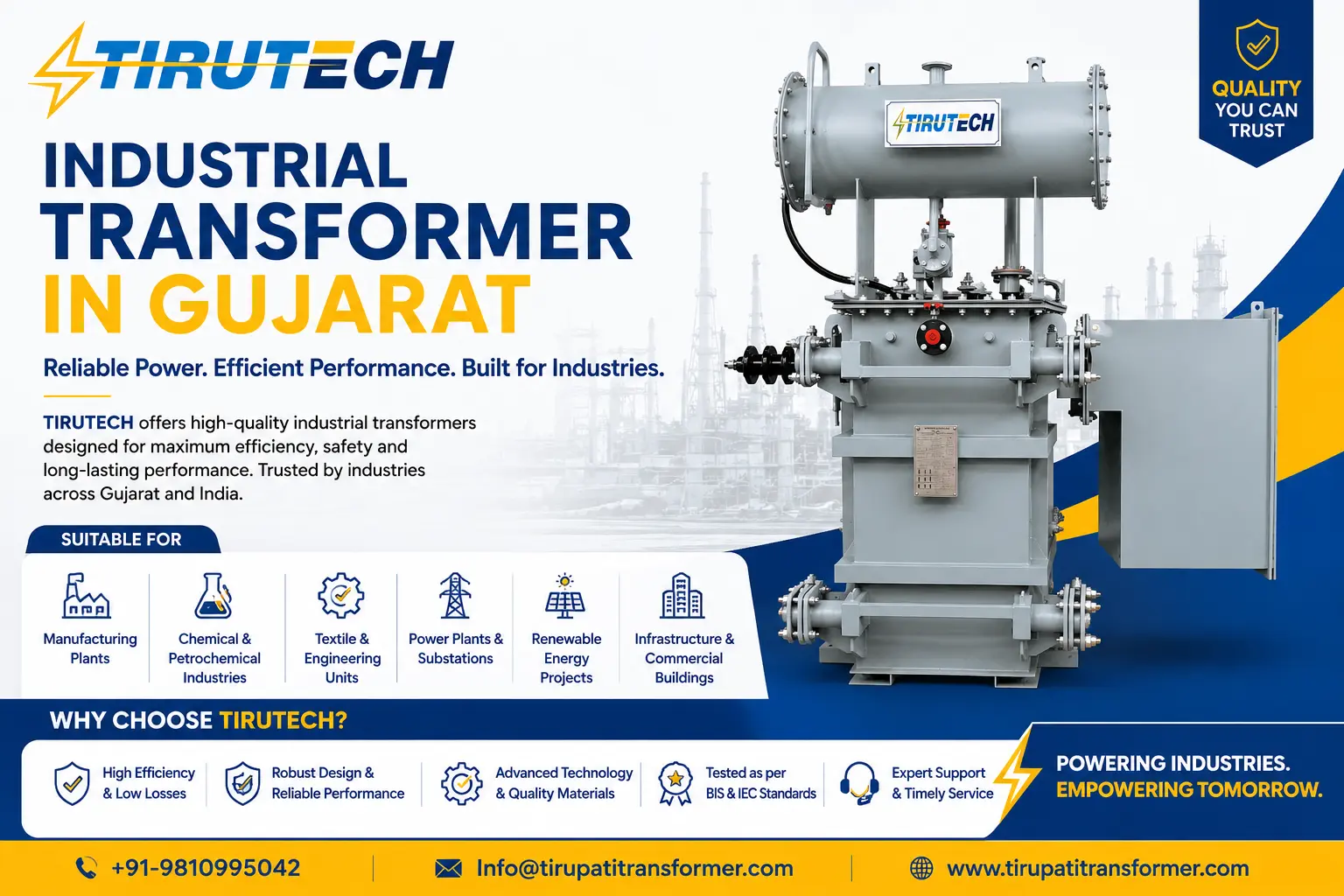
What Is an Industrial Transformer?
An industrial transformer is an electrical transformer used to transfer electrical energy between circuits and change the voltage level according to the requirements of an industrial electrical system.
Transformers are commonly used to step voltage up or down while maintaining the system frequency. In industrial facilities, they form an important part of power distribution and electrical infrastructure.
An industrial transformer in Gujarat may be used in:
- Manufacturing plants
- Chemical and petrochemical facilities
- Textile industries
- Pharmaceutical plants
- Steel plants
- Cement plants
- Engineering industries
- Solar power projects
- Infrastructure projects
- Data centres
- Commercial buildings
- Industrial substations
The final transformer configuration should always be based on the approved electrical design, site conditions and project specifications.
Why Is Transformer Selection Important for Gujarat Industries?
Industrial electrical systems are not identical.
A manufacturing facility may have large motors, variable-frequency drives and production machinery. A chemical plant may operate continuous-process equipment. A pharmaceutical facility may have specific indoor installation and safety requirements. A solar project has inverter-based generation and a different electrical operating profile.
This means there is no single transformer configuration that is suitable for every industrial application.
A properly specified industrial transformer can help support:
- Reliable power distribution
- Appropriate voltage transformation
- Efficient operation
- Controlled electrical losses
- Suitable thermal performance
- Long-term operational reliability
- Easier maintenance
- Future expansion
For Gujarat industrial projects, transformer selection should therefore begin with understanding the project’s actual electrical requirements.
1. Determine the Required Transformer Capacity
Transformer capacity is normally specified in kVA or MVA.
The first step is to understand the actual electrical load that the transformer will supply.
Consider:
- Connected load
- Maximum demand
- Power factor
- Load factor
- Diversity factor
- Motor loads
- Motor starting current
- Continuous and intermittent loads
- Existing electrical load
- Planned future expansion
- Required operating margin
For a three-phase system, apparent power can be estimated using:
kVA = √3 × Voltage × Current ÷ 1000
However, this calculation alone should not be treated as the final transformer-sizing method for an industrial plant.
The electrical engineer should also evaluate the plant load profile, power factor, motor starting, harmonic-producing equipment, ambient conditions and future expansion requirements.
Avoid both under-sizing and excessive oversizing
An undersized transformer can result in:
- Overloading
- Excessive heating
- Voltage problems
- Reduced service life
- Unplanned interruptions
An excessively oversized transformer can result in:
- Higher initial cost
- Larger footprint
- Higher no-load losses
- Unnecessary operating costs
The objective is to select an appropriate transformer capacity based on actual and reasonably expected operating conditions.
2. Check Primary and Secondary Voltage
The transformer’s voltage ratio must match the electrical system.
Before requesting a quotation, confirm:
- Primary voltage
- Secondary voltage
- Frequency
- Number of phases
- Highest voltage for equipment
- Insulation requirements
- Earthing arrangement
- Required tap range
Industrial sites may have different HT supply arrangements depending on the utility connection and project requirements. Therefore, the exact transformer voltage should be taken from the approved electrical single-line diagram, utility requirements and project specification.
The transformer manufacturer should receive the correct voltage information before preparing the technical design and quotation.
3. Understand the Industrial Load
The connected load has a direct impact on transformer selection.
Identify major electrical equipment such as:
- Motors
- Pumps
- Compressors
- HVAC systems
- Furnaces
- Welding equipment
- Variable-frequency drives
- UPS systems
- Rectifiers
- Inverters
- Production machinery
Different loads affect transformer performance differently.
Motor Loads
Large motors can create high starting currents, which should be considered during transformer sizing and system design.
VFD Loads
Variable-frequency drives can introduce harmonic currents. The transformer specification should therefore consider the actual quantity and characteristics of VFD loads.
Inverter Loads
Solar and other inverter-based systems have specific electrical characteristics that should be considered when selecting the transformer.
Continuous-Process Loads
Chemical, pharmaceutical and other process industries may operate continuously, making thermal performance and reliability particularly important.
Providing a detailed load schedule to the transformer manufacturer can help improve the technical accuracy of the proposal.
4. Select the Correct Transformer Type
The appropriate transformer type depends on the application, voltage level, capacity, installation environment and project specification.
Power Transformer
Power transformers are generally used for higher-capacity power-system and substation applications.
They can be considered for:
- Large industrial substations
- High-capacity industrial facilities
- Infrastructure projects
- Power-system applications
- Higher-capacity transformation requirements
The IEC 60076 series provides an international reference framework for power transformers, with IEC 60076-1 covering general requirements.
Distribution Transformer
Distribution transformers are commonly used to step down electrical voltage for distribution to industrial, commercial and other end-use loads.
Applications may include:
- Factories
- Industrial facilities
- Commercial buildings
- Institutional facilities
- Distribution networks
The BIS IS 1180 series covers distribution transformers.
Dry-Type Transformer
Dry-type transformers use solid insulation systems instead of liquid insulation.
They may be considered for:
- Indoor industrial installations
- Commercial facilities
- Buildings
- Specific fire-safety applications
- Locations where liquid insulation is undesirable
The final selection should depend on the project environment, electrical requirements and applicable specifications.
Cast Resin Transformer
Cast resin transformers are a type of dry-type transformer in which the windings use cast resin insulation.
They may be considered for:
- Indoor substations
- Industrial facilities
- Commercial buildings
- Pharmaceutical facilities
- Applications with specific fire-safety or environmental requirements
Solar Inverter Duty Transformer
For Gujarat solar projects, Solar Transformer in Gujarat solutions should be selected based on inverter output, voltage level, harmonic characteristics and grid requirements.
The transformer design should consider:
- Inverter output
- Voltage level
- Harmonic characteristics
- Loading pattern
- Temperature conditions
- Grid connection requirements
- Protection requirements
- Project-specific technical specifications
This is particularly relevant for solar and renewable-energy projects in Gujarat.
Compact Substation
A compact substation combines transformer and associated switchgear equipment into an integrated arrangement.
It can be considered for projects where:
- Space is limited
- A compact electrical installation is required
- Factory-assembled equipment is preferred
- Civil and installation requirements need to be optimized
5. Power Transformer vs Distribution Transformer
One of the most common questions from industrial buyers is:
Should I purchase a power transformer or a distribution transformer?
The answer depends on the electrical system rather than simply the capacity.
| Factor | Power Transformer | Distribution Transformer |
| Primary application | Higher-capacity power systems and substations | Distribution and end-use supply |
| Typical use | Industrial substations and power systems | Industrial and commercial distribution |
| Selection basis | System and project specification | Load and distribution requirements |
| Installation | Substations / large electrical systems | Industrial / commercial / distribution systems |
| Final selection | Project-specific | Project-specific |
A qualified electrical engineer should determine the appropriate configuration based on the project’s electrical single-line diagram and technical requirements.
6. Oil-Immersed vs Dry-Type Transformer
Another important decision is whether the project requires an oil-immersed or dry-type transformer.
Oil-Immersed Transformer
Oil-immersed transformers use insulating liquid for electrical insulation and heat transfer.
They are widely used in:
- Outdoor substations
- Industrial power systems
- Distribution applications
- Higher-capacity installations
Dry-Type Transformer
Dry-type transformers do not use liquid insulation.
They can be considered for:
- Indoor installations
- Commercial buildings
- Industrial facilities
- Specific fire-safety applications
- Locations where liquid containment is undesirable
The final choice should consider capacity, installation environment, fire-safety requirements, maintenance requirements and project specifications.
7. Consider Harmonics and Non-Linear Loads
Modern industrial plants increasingly use power-electronic equipment such as:
- Variable-frequency drives
- UPS systems
- Solar inverters
- Rectifiers
- Switching power supplies
These systems can produce harmonic currents.
Where harmonic-producing loads form a significant part of the plant, transformer selection should consider:
- Harmonic current
- Additional heating
- Thermal performance
- Neutral current where relevant
- Load profile
- Project-specific requirements
A transformer should therefore be selected according to the actual electrical characteristics of the plant.
8. Select the Appropriate Cooling Arrangement
Transformer losses generate heat, making thermal design essential.
For oil-immersed transformers, common cooling arrangements include:
ONAN
Oil Natural Air Natural
ONAF
Oil Natural Air Forced
The appropriate cooling arrangement depends on:
- Transformer rating
- Load profile
- Ambient temperature
- Required temperature rise
- Site conditions
- Project specification
Cooling should be selected as part of the overall transformer design.
9. Consider Gujarat’s Site and Environmental Conditions
Site conditions can significantly influence transformer selection.
For an industrial transformer in Gujarat, consider:
- Ambient temperature
- Dust
- Humidity
- Coastal atmosphere
- Salt contamination
- Industrial pollution
- Chemical exposure
- Indoor or outdoor installation
- Ventilation
- Available space
- Accessibility
- Site altitude
Industrial sites in coastal regions may require additional attention to corrosion protection and enclosure/painting specifications. Similarly, locations with high ambient temperatures may require appropriate thermal design.
The transformer should be specified according to the actual project site rather than assuming that one environmental configuration suits every Gujarat installation.
10. Evaluate Tap Changer Requirements
Tap changers allow adjustment of the transformer’s voltage ratio within a specified range.
Off-Circuit Tap Changer
The tap position is changed only after the transformer has been de-energized.
On-Load Tap Changer
The voltage ratio can be adjusted while the transformer is in service, subject to the applicable equipment and control system.
The requirement depends on:
- Grid voltage variation
- Load variation
- Voltage regulation requirements
- Utility requirements
- Project specifications
Tap range and tapping positions should be clearly defined before manufacturing.
11. Compare Transformer Efficiency and Losses
Transformer price should not be the only purchasing criterion.
Transformers operate for many years, so losses can contribute significantly to the total cost of ownership.
Important parameters include:
- No-load loss
- Load loss
- Total losses
- Efficiency
- Operating load profile
An energy-efficient transformer with appropriately controlled losses may provide better long-term economics even when its initial purchase price is higher.
For industrial procurement, compare:
Initial Purchase Cost + Lifetime Operating Cost
rather than considering only the initial quotation.
12. Check BIS and IEC Standards
Standards are a critical part of transformer specification.
For Indian projects, applicable standards depend on transformer type and application.
Important references include:
- IS 1180 series – Distribution transformers
- IS 2026 series – Power transformers
- IEC 60076 series – Power transformer standards
BIS provides transformer-related standards and technical information covering areas such as ratings, voltage ratios, tapping, losses and impedance.
Always confirm the latest applicable edition and the specific requirements of the project before finalizing the transformer specification.
13. Verify Manufacturer Certifications and Test Reports
When evaluating an industrial transformer manufacturer in Gujarat, do not rely only on statements such as “certified manufacturer” or “tested transformer.”
Ask for documentary evidence relevant to your project.
Depending on the product and applicable requirements, buyers may need to verify:
- Applicable BIS licence
- ISO 9001 certification
- Relevant registration documents
- Routine test reports
- Type-test reports where applicable
- Special test reports where applicable
- Product-specific compliance documentation
Certification claims should be verified with the issuing authority wherever possible.
This is particularly important for EPC contractors, consultants and procurement teams purchasing transformers for large industrial projects.
14. Transformer Testing and Quality Verification
Testing is an important part of transformer quality assurance.
Depending on the transformer type, applicable standard and project specification, testing can include:
- Winding resistance
- Voltage ratio
- Phase displacement
- No-load loss
- Load loss
- Impedance
- Dielectric tests
- Insulation-related tests
- Temperature-rise tests
- Leak or pressure tests where applicable
- Type and special tests where specified
Before purchasing, ask the manufacturer which tests apply to your transformer and request the corresponding documentation.
Testing requirements should be agreed during the technical-commercial stage rather than after manufacturing.
15. Consider Future Industrial Expansion
Transformer selection should not consider only today’s electrical load.
If the plant is expected to expand, consider:
- Additional production lines
- New motors
- Additional HVAC load
- New machinery
- Additional process equipment
- Additional solar generation
- New buildings
- Increased production capacity
However, future capacity should be based on a realistic load forecast.
Excessive oversizing can increase initial cost and no-load losses, while insufficient capacity can create operational problems.
The objective is to provide an appropriate engineering margin without unnecessary oversizing.
Need an Industrial Transformer for Your Gujarat Project?
Share your transformer requirements and get a project-specific quotation from Tirupati Transformer.
What Information Should You Give a Transformer Manufacturer?
A detailed enquiry helps the manufacturer prepare a technically appropriate proposal.
Before requesting a quotation, provide:
Transformer Specification Requirements
| Parameter | Information / Requirement |
|---|---|
| Application | Industrial / Solar / Commercial / Infrastructure |
| Capacity | kVA / MVA |
| Primary Voltage | Required HV voltage |
| Secondary Voltage | Required LV/MV voltage |
| Frequency | Usually 50 Hz in India |
| Phase | Single / Three Phase |
| Construction | Oil-immersed / Dry Type |
| Cooling | As per project requirement |
| Tap Changer | Off-circuit / On-load |
| Installation | Indoor / Outdoor |
| Site Location | Gujarat project location |
| Load Type | Motor / VFD / UPS / Inverter / Mixed |
| Harmonics | Available study/data if applicable |
| Vector Group | As required |
| Impedance | Project specification |
| Standards | Applicable BIS / IEC standard |
| Future Load | Expected expansion |
| Testing | Routine / Type / Special tests |
| Accessories | Project requirement |
If you do not know the exact transformer capacity, provide your available load data and electrical details to the manufacturer or project electrical engineer.
Industrial Transformer Applications in Gujarat
An industrial transformer in Gujarat may be required across many industrial sectors.
Chemical and Petrochemical Industry
Chemical and petrochemical facilities may operate continuous-process equipment, motors, pumps and compressors. Transformer selection should consider load profile, site environment, reliability and applicable project specifications.
Textile Industry
Textile manufacturing facilities can have multiple motors, drives and production machines. Load characteristics and harmonic-producing equipment should be considered during transformer specification.
Pharmaceutical Industry
Pharmaceutical facilities may have specific requirements related to electrical reliability, indoor installations and environmental conditions. Dry-type or cast resin transformers may be considered where appropriate.
Steel and Heavy Engineering
Heavy industrial facilities can have high-capacity and dynamic loads. Transformer selection may require consideration of motors, furnaces, large drives, short-circuit levels and harmonics.
Cement Industry
Cement plants can include large motors, conveyors, crushers, mills, fans and other high-power equipment. Transformer capacity and thermal performance should be selected according to the plant’s actual load schedule.
Solar and Renewable Energy
Solar and renewable-energy projects require coordination between inverter systems, transformers, grid connections and protection systems.
This makes solar inverter duty transformers an important consideration for renewable-energy installations.
Manufacturing and Engineering
General manufacturing facilities may require distribution or power transformation depending on plant capacity, voltage requirements and electrical architecture.
How to Select an Industrial Transformer Manufacturer in Gujarat
Choosing the manufacturer is as important as selecting the transformer.
Before placing an order, evaluate:
1. Technical Capability
Can the manufacturer design the transformer according to your exact electrical specification?
2. Product Range
Does the manufacturer offer the transformer type and capacity required for your application?
3. Manufacturing Capability
Does the manufacturer have appropriate manufacturing and quality-control processes?
4. Testing Capability
Can the required routine, type or special tests be performed and documented?
5. Technical Documentation
Ask for:
- Technical datasheet
- General arrangement drawing
- Rating information
- Test reports
- Loss data
- Installation documentation
- Operation and maintenance information
6. After-Sales Support
Evaluate:
- Technical support
- Installation assistance
- Commissioning support
- Warranty
- Service support
7. Application Experience
A manufacturer that understands industrial load requirements can provide a more project-specific technical solution.
Why Choose Tirupati Transformer?
Tirupati Transformer has been manufacturing transformer solutions since 2014 and operates from its manufacturing facility in Greater Noida, NCR.
Its product portfolio includes:
- Power Transformers
- Distribution Transformers
- Solar Inverter Duty Transformers
- Dry-Type Transformers
- Cast Resin Transformers
- Compact Substations
- VPI Transformers
- Servo Voltage Stabilizers
The company serves industrial, commercial, infrastructure and renewable-energy applications.
For Gujarat projects, transformer requirements can vary according to industry, location, voltage level, capacity, load profile and installation environment.
Tirupati Transformer can discuss your project requirements and help you move toward an appropriate transformer configuration based on the technical information provided.
Looking for a Transformer Manufacturer in Gujarat?
Industrial Transformer in Gujarat: Buyer Checklist
Before finalizing your transformer, check:
✓ Required kVA/MVA capacity
✓ Primary voltage
✓ Secondary voltage
✓ Frequency
✓ Load profile
✓ Motor starting requirements
✓ Harmonic loads
✓ Oil or dry-type construction
✓ Cooling arrangement
✓ Tap changer requirement
✓ Installation environment
✓ Ambient temperature
✓ Future expansion
✓ Transformer losses
✓ Applicable BIS/IEC standards
✓ Testing requirements
✓ Technical documentation
✓ Warranty and service support
A properly prepared technical specification can reduce misunderstandings during procurement and help the manufacturer prepare a more suitable proposal.
Frequently Asked Questions About Industrial Transformers in Gujarat
Q1. What is an industrial transformer?
Ans: An industrial transformer is a transformer used to change voltage levels and support electrical power distribution in industrial facilities. Its configuration depends on capacity, voltage, load characteristics, installation conditions and project requirements.
Q2. How do I choose an industrial transformer in Gujarat?
Ans: To choose an industrial transformer in Gujarat, evaluate the required capacity, primary and secondary voltage, load characteristics, transformer type, cooling, installation environment, losses, tap changer, applicable standards, testing requirements and future expansion.
Q3. Which transformer is best for an industrial plant?
Ans: There is no single transformer that is best for every industrial plant. Power transformers, distribution transformers, dry-type transformers, cast resin transformers and application-specific transformers can all be suitable depending on the electrical system.
Q4. What capacity transformer does an industrial plant need?
Ans: Capacity depends on connected load, maximum demand, power factor, motor starting, load profile and future expansion. The final rating should be established through the project’s electrical design rather than a generic capacity rule.
Q5. Is a dry-type transformer suitable for industrial applications?
Ans: Yes. Dry-type transformers can be suitable for many indoor industrial and commercial applications. The final choice depends on capacity, installation environment, fire-safety requirements, electrical characteristics and project specifications.
Q6. What is the difference between a power transformer and a distribution transformer?
Ans: A power transformer is generally associated with higher-capacity power-system and substation applications, while a distribution transformer is generally used for voltage transformation in distribution systems. The actual selection depends on the electrical system and project specification.
Q7. Are BIS standards important for industrial transformers in India?
Ans: Yes. Applicable BIS standards should be identified according to transformer type and application. The IS 1180 series is associated with distribution transformers and the IS 2026 series with power transformers.
Q8. What information should I provide for a transformer quotation?
Ans: Provide capacity, primary and secondary voltage, application, installation location, load details, cooling requirement, transformer type, tap changer requirement, applicable standards and project-specific technical specifications.
Q9. Do I need a transformer manufacturer based in Gujarat?
Ans: Not necessarily. A manufacturer located outside Gujarat can also supply an industrial transformer to Gujarat. What matters is technical capability, applicable certification, quality documentation, reliable logistics and confirmed after-sales support for the project site.
Q10. Can Tirupati Transformer supply transformers for Gujarat industrial projects?
Ans: Yes. Tirupati Transformer serves industrial, commercial, infrastructure and renewable-energy transformer requirements across India. For Gujarat projects, customers can share capacity, voltage, application and site requirements for a technical discussion and quotation.
Q11. What type of transformer is used for solar projects in Gujarat?
Ans: Solar projects generally require transformers selected according to inverter output, voltage level, harmonic characteristics, loading profile, cooling requirements and grid-connection specifications. For project-specific requirements, see our Solar Transformer in Gujarat page.
Conclusion
Selecting the right industrial transformer in Gujarat requires a detailed understanding of the project’s electrical requirements.
Capacity, voltage, load characteristics, transformer type, cooling, harmonics, efficiency, installation environment, standards, testing and future expansion should all be evaluated before finalizing the transformer.
For industrial buyers, EPC contractors, consultants and procurement teams, the best approach is to prepare a clear technical specification and compare manufacturers on technical capability, testing, documentation, quality, service and total cost of ownership—not only the initial quotation.
If you are planning a manufacturing plant, industrial facility, solar project, infrastructure project or commercial-industrial installation in Gujarat, Tirupati Transformer can discuss your transformer requirements based on your project specifications.
Need an Industrial Transformer for Your Gujarat Project?
Get a project-specific transformer recommendation from Tirupati Transformer.
Share your capacity, voltage, application and load details to request a quotation.
Call: +91-9810995042