 Sushil Singh 1 June 2026
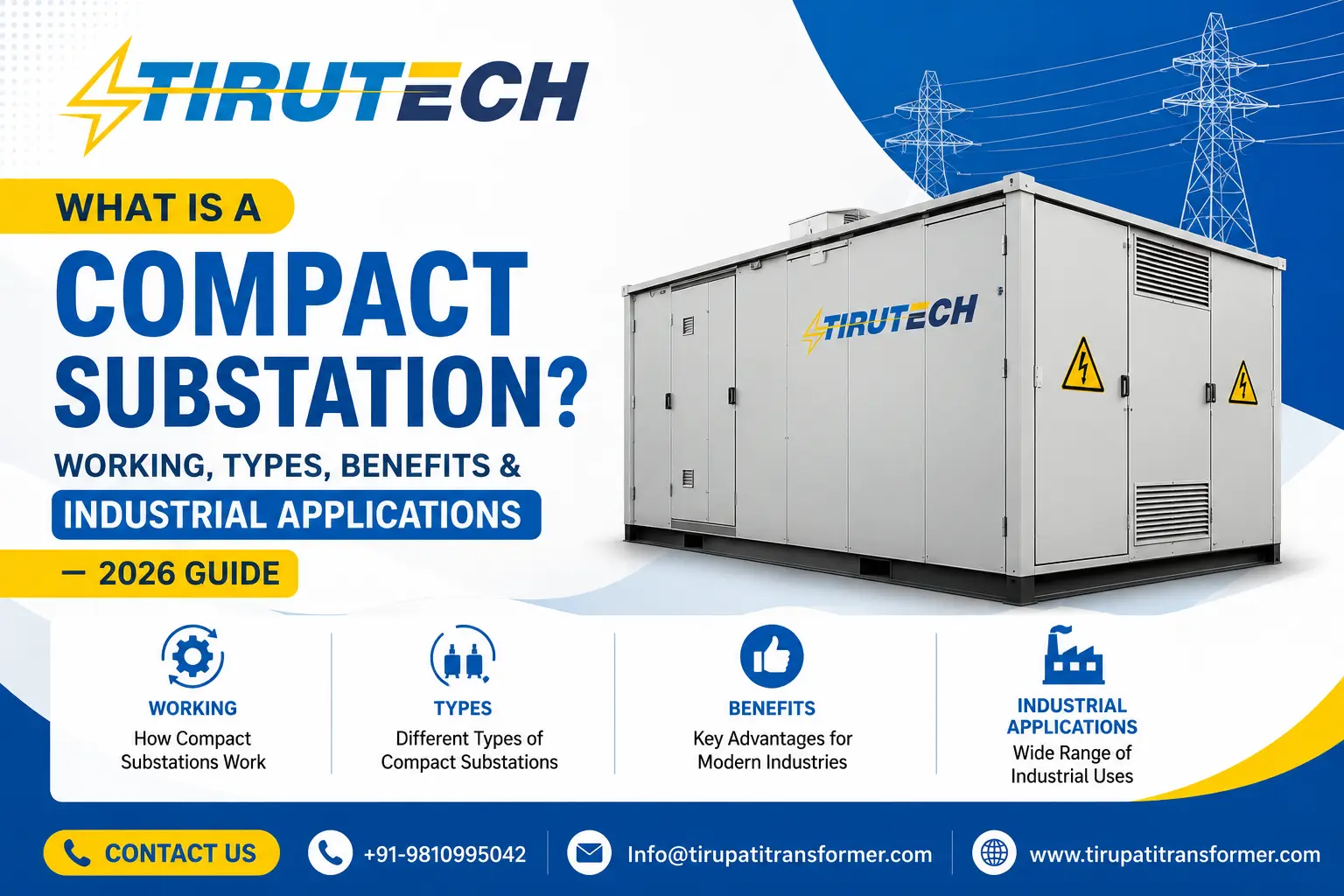
A Compact Substation is a factory-integrated power distribution system that combines MV switchgear, a distribution transformer and LV distribution equipment within a coordinated enclosure. It receives medium-voltage power, transforms it to the required voltage and distributes electricity safely to downstream loads.
This Compact Substation Guide explains the technology from an engineering and buyer’s perspective — including how a compact substation works, its major components, types, applications, technical specifications, applicable standards, selection criteria, maintenance requirements, cost factors and the questions you should ask before ordering one.
For industrial plants, commercial buildings, infrastructure projects, residential developments and renewable-energy installations, the right substation design depends on much more than transformer capacity. Voltage level, fault level, protection coordination, load characteristics, environmental conditions, cable arrangement, ventilation and future expansion all influence the final configuration.
Tirupati Transformer develops transformer and compact-substation solutions for project-specific electrical requirements, with the objective of combining the transformer, MV equipment and LV distribution system into a coordinated package.
What Is a Compact Substation?
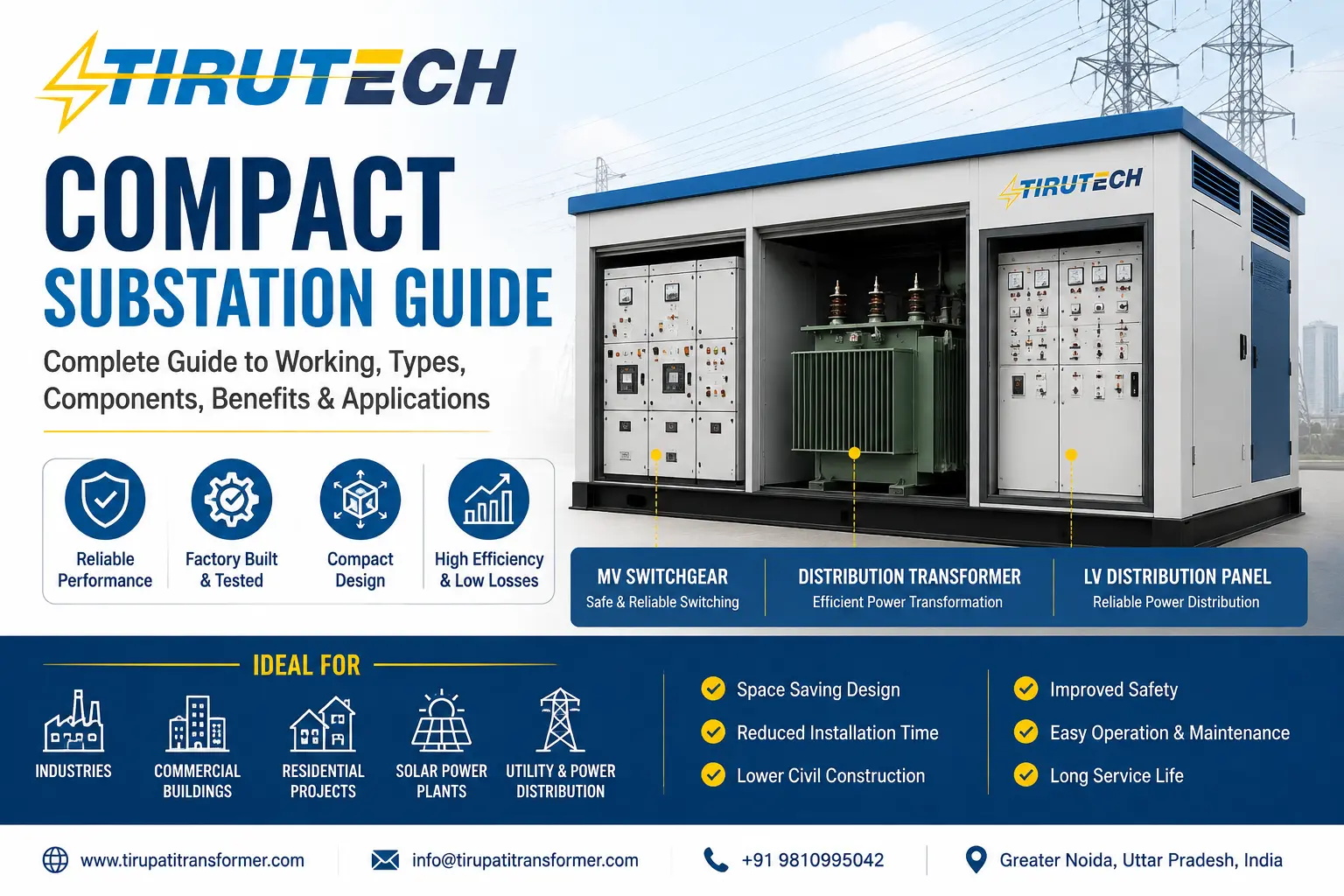
A Compact Substation is a factory-integrated electrical distribution system that combines MV switchgear, a transformer and LV distribution equipment within a coordinated enclosure.
A typical system can include:
- MV switchgear or RMU
- Distribution transformer
- LV distribution panel
- Protection equipment
- Metering equipment
- Busbars
- Cable termination arrangements
- Earthing provisions
- Weather-resistant enclosure
- Internal interconnections
The basic electrical path is:
MV Incoming Supply → MV Switchgear → Transformer → LV Panel → Outgoing Feeders → Electrical Loads
Unlike a conventional site-built substation, where equipment and civil infrastructure may be installed and interconnected separately, a prefabricated or package substation is designed as a coordinated assembly.
The exact configuration varies according to the project’s voltage, transformer rating, utility requirements, protection philosophy and installation environment.
Compact Substation Guide: How Does a Compact Substation Work?
The working principle can be understood in four stages.
1. MV Power Incoming
Medium-voltage electrical power enters the MV switchgear section.
Depending on the project, the incoming arrangement may use an RMU, switch-disconnector, circuit breaker or another approved MV switching configuration.
This section provides functions such as:
- Switching
- Isolation
- Protection
- Fault interruption
- Cable connection
- Electrical indication
The final switchgear selection should be based on the network fault level and project protection requirements.
2. Voltage Transformation
After switching and protection, electrical power reaches the transformer.
The transformer changes the incoming voltage to the required secondary voltage for the downstream distribution system.
For example, a project may receive power at an MV level and transform it to an LV distribution voltage suitable for industrial or commercial loads.
Transformer selection should consider:
- kVA/MVA rating
- Primary voltage
- Secondary voltage
- Frequency
- Vector group
- Impedance
- Losses
- Cooling arrangement
- Insulation system
- Ambient conditions
- Harmonic loading
- Future load growth
3. LV Power Distribution
The transformer’s secondary output feeds the LV panel.
The panel can distribute power through multiple outgoing feeders using equipment such as:
- ACBs
- MCCBs
- Busbars
- CTs
- Energy meters
- Protection relays
- Surge protection devices
- Feeder protection
The LV panel should be designed from the actual load schedule instead of simply selecting the largest available breaker.
4. Supply to End Loads
The outgoing feeders then distribute electricity to the connected loads.
These may include:
- Motors
- Pumps
- HVAC systems
- Production machinery
- Building services
- Lighting
- Data-centre loads
- Renewable-energy equipment
- Infrastructure systems
Compact Substation Guide: Main Components Explained
1. MV Switchgear / RMU
The MV section controls the incoming and outgoing medium-voltage circuits.
Depending on the application, it may include:
- Ring Main Unit
- Switch-disconnector
- Vacuum circuit breaker
- Protection relay
- Fuses
- Voltage indication
- Earthing switch
- Mechanical interlocking
The selected MV equipment should match the system’s rated voltage, current, short-circuit withstand requirement and protection coordination.
2. Distribution Transformer
The transformer is the central voltage-conversion component of the Compact Substation.
Its performance directly affects:
- Energy efficiency
- Voltage regulation
- Temperature rise
- Operating losses
- Reliability
- Long-term operating cost
Important transformer parameters include:
| Parameter | Why It Matters |
|---|---|
| Transformer Rating | Determines available capacity |
| HV Voltage | Must match incoming network |
| LV Voltage | Must match distribution system |
| Impedance | Influences fault current and voltage regulation |
| Vector Group | Determines phase relationship |
| No-Load Loss | Occurs whenever transformer remains energized |
| Load Loss | Changes with loading |
| Cooling | Affects thermal performance |
| Insulation | Determines dielectric performance |
| Temperature Rise | Important for reliable operation |
For applicable distribution transformers, Indian Standards include the IS 1180 series. BIS describes IS 1180 as covering distribution transformers, including three-phase units up to 2,500 kVA and nominal system voltages up to 33 kV in the relevant standard scope.
3. LV Distribution Panel
The LV panel distributes transformer output to individual loads.
A project-specific LV panel can contain:
- ACB incomer
- MCCB outgoing feeders
- Copper or aluminium busbars
- CTs
- Energy meter
- Protection
- Surge protection
- Cable termination
- Indication and control equipment
The number of outgoing feeders should be determined from the project’s electrical load schedule.
4. Enclosure
The enclosure provides mechanical and environmental protection to the integrated electrical equipment.
Important design considerations include:
- IP protection
- Ventilation
- Temperature rise
- Corrosion protection
- Cable entry
- Access doors
- Maintenance clearance
- Earthing
- Internal segregation
- Rain and dust protection
Outdoor installations require particular attention to ambient temperature, humidity, dust, solar radiation and corrosion.
Compact Substation Guide: Types and Configurations
A Compact Substation is not limited to one physical configuration. The appropriate design depends on the project environment and electrical application.
Outdoor Compact Substation
Outdoor units are commonly considered for:
- Industrial plants
- Residential townships
- Commercial developments
- Solar projects
- Utility distribution
- Infrastructure projects
The enclosure and ventilation system should be engineered for the actual site conditions.
For example, a substation installed in a high-temperature region may require a different thermal design from one installed in a cooler environment.
Indoor Compact Substation
Indoor Compact Substations are designed for electrical rooms, buildings and other controlled environments.
Applications can include:
- Hospitals
- Commercial buildings
- Data centres
- Industrial buildings
- Metro infrastructure
- Institutional campuses
For indoor installations, transformer technology, ventilation, fire-safety requirements, access and room dimensions must be considered together.
Solar Compact Substation
Solar power is an increasingly important application area for modern transformer and substation systems.
A solar Compact Substation may integrate:
- Inverter output
- Step-up transformer
- MV switchgear
- Protection
- Metering
- Grid connection equipment
Solar applications require additional attention to:
- Inverter harmonics
- Variable generation
- Thermal cycling
- Bidirectional power flow
- Grid protection
- Transformer loading profile
- Outdoor environmental conditions
India’s solar deployment continues to create demand for supporting electrical infrastructure. Mercom India reported 27 GW of solar capacity additions during the first half of 2026, making solar-related electrical infrastructure an important current industry topic.
For transformer requirements associated with solar projects, see the Solar Inverter Duty Transformer.
Compact Secondary Substation
A Compact Secondary Substation, often abbreviated as CSS, is used in distribution applications where medium-voltage power needs to be transformed and distributed close to the load.
Utility projects may impose their own:
- Equipment specifications
- Protection requirements
- Metering arrangements
- Approved-vendor requirements
- Civil requirements
- Earthing requirements
- Inspection procedures
Therefore, utility approval should always be checked before final equipment selection.
Compact Substation vs Conventional Substation
The two approaches solve similar distribution problems but use different project architectures.
| Factor | Compact Substation | Conventional Substation |
| Equipment integration | High | Usually separate |
| Factory assembly | Major advantage | Varies |
| Site installation | Generally simplified | More site activities |
| Space utilisation | Compact | Usually requires more space |
| Civil infrastructure | Can be reduced | Often more extensive |
| Customisation | Project-specific | Project-specific |
| Relocation | Possible for suitable designs | Generally difficult |
| Commissioning approach | Integrated equipment testing possible | More site coordination |
| Typical advantage | Space and installation efficiency | Large/specialised installations |
There is no universal rule that one solution is always better. Large-capacity substations, complex utility systems and unusual site requirements may justify conventional construction.
The correct decision should be based on engineering requirements rather than equipment price alone.
Key Benefits of a Compact Substation
Space Optimisation
The integrated arrangement can reduce the footprint required for electrical distribution equipment.
This is valuable where land availability is limited, particularly in:
- Urban developments
- Industrial parks
- Commercial buildings
- Solar sites
- Infrastructure projects
Faster Project Execution
Factory integration can reduce the amount of equipment assembly and coordination required at the project site.
The actual project schedule still depends on:
- Civil readiness
- Equipment delivery
- Cable installation
- Utility approvals
- Inspection
- Testing
- Commissioning
Therefore, installation time should be evaluated project by project.
Factory-Controlled Assembly
A manufacturer can inspect and test equipment before dispatch.
This provides an opportunity to verify:
- Equipment interfaces
- Internal wiring
- Protection
- Mechanical arrangements
- Transformer performance
- LV panel functionality
Reduced Site Complexity
A coordinated package can simplify communication between:
- Electrical contractor
- Civil contractor
- Transformer manufacturer
- Switchgear supplier
- Project consultant
- Utility authority
Better Equipment Coordination
The transformer, MV switchgear, LV panel and enclosure can be designed as one system.
This allows engineers to consider:
- Clearances
- Cable routing
- Heat dissipation
- Protection
- Maintenance access
- Earthing
- Equipment segregation
Compact Substation Applications
Industrial Plants
Industrial facilities often have mixed electrical loads such as:
- Motors
- Pumps
- Compressors
- Furnaces
- Drives
- HVAC
- Production machinery
The substation should therefore be selected after reviewing maximum demand, starting current, harmonics, power factor and future expansion.
For related transformer requirements, explore the Distribution Transformer range.
Manufacturing Facilities
Automotive, engineering, textile, food-processing, cement, steel and other manufacturing facilities may use compact distribution systems where electrical equipment needs to be positioned close to the load centre.
Commercial Buildings
Applications include:
- Office complexes
- Shopping centres
- Hotels
- Business parks
- IT facilities
- Large commercial buildings
Space optimisation and maintenance access are especially important in these projects.
Hospitals
Healthcare facilities require careful consideration of:
- Electrical safety
- Continuity of supply
- Fire safety
- Maintenance access
- Emergency systems
- Documentation
Indoor installations require particular attention to transformer type, ventilation and room configuration.
Residential Townships
Large residential developments may use compact distribution substations to supply multiple buildings or distribution zones.
The design should consider:
- Load diversity
- Future occupancy
- Utility requirements
- Cable routing
- Safety clearances
- Maintenance access
Data Centres
Data centres have highly sensitive electrical loads.
A substation design for such applications may need to consider:
- High availability
- Redundancy
- Transformer losses
- Harmonics
- Protection selectivity
- Generator integration
- UPS systems
- Maintenance strategy
The substation should be part of the overall electrical reliability architecture rather than evaluated as an isolated product.
Compact Substation for Renewable Energy Projects
Renewable-energy projects have introduced additional considerations for transformer and MV equipment.
Solar inverter-based systems can create operating conditions different from traditional industrial loads.
Engineers should consider:
- Inverter output characteristics
- Harmonic current
- Reactive power requirements
- Grid-code requirements
- Transformer thermal behaviour
- MV collection voltage
- Protection coordination
- Bidirectional power flow
This makes the solar substation a specialised application rather than simply a conventional substation with a different name.
For current renewable-energy policy and programme information, consult the Ministry of New and Renewable Energy.
How to Select a Compact Substation
A good Compact Substation Guide should not stop at explaining the equipment. It should also help buyers make the right specification.
Step 1: Calculate the Load
Prepare:
- Connected load
- Maximum demand
- Diversity factor
- Motor loads
- Starting requirements
- Existing transformer loading
- Future expansion
Do not select the transformer only from the total connected load.
Step 2: Confirm HV Voltage
Identify the actual utility/network voltage.
Common distribution levels can include:
- 11 kV
- 22 kV
- 33 kV
The final voltage must be confirmed from the approved electrical design and utility requirement.
Step 3: Determine Transformer Capacity
Select the required kVA/MVA after considering:
- Present demand
- Future growth
- Load diversity
- Ambient temperature
- Harmonics
- Motor starting
- Required reserve margin
Step 4: Select Transformer Type
Depending on the application, the transformer may be:
Oil-immersed Transformer
Often considered for outdoor distribution applications.
Dry-Type Transformer
Can be suitable for applications where oil-free construction is preferred or required.
For more information, see the Cast Resin Dry-Type Transformer resource.
Step 5: Define MV Switchgear
Confirm:
- Rated voltage
- Rated current
- Short-circuit rating
- Switching arrangement
- Protection
- Metering
- Earthing switch
- Cable termination
- Interlocking
Step 6: Design the LV Panel
Specify:
- Incomer rating
- Number of outgoing feeders
- Feeder ratings
- Breaker type
- Busbar rating
- Metering
- Protection
- Cable entry
Step 7: Evaluate the Site
Consider:
- Ambient temperature
- Altitude
- Dust
- Humidity
- Rain
- Corrosive atmosphere
- Solar radiation
- Flooding risk
- Indoor ventilation
- Available footprint
Compact Substation Standards and Compliance
Standards and statutory requirements should be checked against the exact equipment and project specification. This Compact Substation Guide also highlights the importance of checking applicable electrical standards before final equipment selection.
IEC 62271-202
IEC 62271-202:2022 covers AC prefabricated substations for rated voltages above 1 kV up to and including 52 kV. It addresses service conditions, rated characteristics, structural requirements and test methods for enclosed high-voltage prefabricated substations.
You can verify the standard directly through the International Electrotechnical Commission (IEC).
CEA Electrical Safety Requirements
In India, electrical installation requirements also need to be evaluated against applicable regulatory requirements.
The Central Electricity Authority publishes the Central Electricity Authority (Measures relating to Safety and Electric Supply) Regulations, including the 2023 regulations and subsequent amendments.
BIS Transformer Standards
BIS publishes standards covering distribution transformers. The IS 1180 series is particularly relevant to applicable distribution-transformer configurations.
For the final project, the consultant, manufacturer and approving authority should establish the exact applicable standards and certification requirements.
Compact Substation Testing and Quality Checks
Testing should be defined according to the equipment and applicable standards.
Transformer Checks
Potential routine tests can include:
- Winding resistance
- Voltage ratio
- Vector group/polarity
- Insulation resistance
- No-load loss
- Load loss
- Impedance
- Dielectric tests
- Other applicable routine or type tests
MV Equipment Checks
These can include:
- Mechanical operation
- Interlocking
- Protection functionality
- Insulation-related testing
- Circuit-breaker operation
- Cable termination inspection
LV Panel Checks
Inspection can include:
- Busbar verification
- Insulation testing
- Breaker operation
- Protection settings
- Metering verification
- Internal wiring checks
Integrated Inspection
The final quality check should verify the interfaces between the transformer, MV switchgear, LV panel and enclosure.
This is important because a Compact Substation is an integrated system, not simply three independent products placed next to each other.
Compact Substation Maintenance Guide
A practical Compact Substation Guide should also explain the inspection and maintenance considerations that affect long-term equipment reliability.
Factory assembly does not mean that a substation requires no maintenance.
A preventive maintenance programme should consider:
- Visual inspection
- Transformer condition
- MV equipment
- LV connections
- Protection settings
- Earthing
- Cable terminations
- Enclosure condition
- Door seals
- Corrosion
- Ventilation
- Temperature
- Signs of overheating
- Moisture ingress
The maintenance interval should follow the manufacturer’s instructions, equipment condition, operating environment and project maintenance programme.
Compact Substation Price in India
This Compact Substation Guide provides the main cost factors buyers should evaluate before comparing quotations.
There is no reliable single Compact Substation price without a technical specification.
The final cost may depend on:
- Transformer rating
- HV voltage
- LV voltage
- Transformer technology
- Transformer losses
- MV switchgear
- RMU/VCB configuration
- LV panel
- Number of feeders
- Protection
- Metering
- Enclosure
- IP protection
- Cable entry
- Environmental requirements
- Testing
- Transportation
- Installation
- Commissioning
Therefore, buyers should compare quotations on a like-for-like technical basis.
A lower equipment price can become expensive over the lifecycle if it comes with higher losses, inadequate protection, unsuitable enclosure design or insufficient documentation.
Compact Substation Buyer Checklist
Before placing a purchase order, verify the following.
Electrical Specification
✓ Transformer Capacity
✓ HV Voltage
✓ LV Voltage
✓ Frequency
✓ Vector Group
✓ Impedance
✓ Transformer Losses
✓ Cooling Arrangement
✓ Short-Circuit Level
MV Switchgear
✓ RMU/VCB Configuration
✓ Rated Current
✓ Fault Withstand Rating
✓ Protection Scheme
✓ Metering
✓ Earthing Switch
✓ Interlocking
LV Panel
✓ Incomer Rating
✓ Outgoing Feeder Quantity
✓ Feeder Ratings
✓ Busbar Rating
✓ CTs
✓ Energy Metering
✓ Surge Protection
Enclosure
✓ IP Protection
✓ Ventilation
✓ Corrosion Protection
✓ Cable Entry
✓ Maintenance Access
✓ Earthing
✓ Environmental Suitability
Documentation
✓ General Arrangement Drawing
✓ Single Line Diagram
✓ Technical Datasheet
✓ Bill of Materials
✓ Routine Test Reports
✓ Applicable Certificates
✓ Operation & Maintenance Manual
✓ Warranty Documentation
What Should You Ask a Compact Substation Manufacturer?
Before selecting a supplier, ask technical questions instead of comparing only prices.
Does the manufacturer actually manufacture the transformer?
Knowing whether the transformer is manufactured in-house or sourced externally can help buyers understand the manufacturer’s control over the critical component.
Will I receive unit-specific test documentation?
Ask for test documentation related to the actual equipment supplied, where applicable.
What transformer losses are guaranteed?
No-load and load losses influence lifecycle energy consumption.
What is the enclosure design?
Ask how ventilation, IP protection, corrosion protection and cable entry have been designed for your site.
How is protection coordinated?
The MV and LV protection systems should be selected with the upstream utility and downstream load protection in mind.
Can the LV panel be customised?
Different projects require different numbers and ratings of feeders.
What happens during commissioning?
Confirm who is responsible for:
- Installation
- Testing
- Energisation
- Commissioning
- Documentation
- Operator training
How does this Compact Substation Guide help buyers?
This Compact Substation Guide helps buyers understand the working principle, components, types, applications, technical specifications, standards, maintenance requirements and key factors to consider before purchasing a Compact Substation.
Why Choose Tirupati Transformer?
Tirupati Transformer is an Indian transformer manufacturer offering transformer and substation solutions for industrial, commercial, infrastructure and renewable-energy applications.
Our approach is based on understanding the electrical requirement first and then configuring the appropriate transformer, MV equipment, LV distribution and enclosure.
For a project-specific Compact Substation requirement, the engineering discussion should cover:
- Required capacity
- HV voltage
- LV voltage
- Application
- Load profile
- Installation environment
- MV protection
- LV feeder configuration
- Metering
- Enclosure requirements
- Applicable standards
- Delivery and commissioning requirements
You can explore the Tirupati Transformer Compact Substation product page for the commercial/product-focused information.
For company background, manufacturing capabilities and product information, visit the Tirupati Transformer website.
Compact Substation: Frequently Asked Questions
Q1. What is a Compact Substation?
A Compact Substation is an integrated electrical distribution unit that combines MV switchgear, a transformer and LV distribution equipment in a coordinated enclosure.
Q2. What is the purpose of a Compact Substation?
Its purpose is to receive medium-voltage electrical power, control and protect the incoming supply, transform the voltage and distribute the resulting low-voltage power to downstream loads.
Q3. What are the main components of a Compact Substation?
The main components are generally MV switchgear, distribution transformer, LV distribution panel, protection equipment, metering, busbars, cable connections and an enclosure.
Q4. What is the difference between a Compact Substation and a Package Substation?
The terms are often used interchangeably in industry. Both generally describe an integrated substation arrangement containing major electrical equipment within a coordinated package.
Q5. What is a Compact Secondary Substation?
A Compact Secondary Substation, or CSS, is a compact distribution substation designed to transform and distribute electrical power closer to the end load or distribution network.
Q6. Is a Compact Substation suitable for solar power plants?
Yes. Compact substations can be engineered for solar projects, but transformer thermal performance, inverter characteristics, harmonics, MV protection and grid-connection requirements must be evaluated.
Q7. What transformer capacity is required for a Compact Substation?
The required capacity depends on maximum demand, load diversity, motor starting, power factor, harmonics, ambient conditions and future expansion. It should be calculated from the project’s load study rather than selected from a generic rating.
Q8. Can a Compact Substation be installed outdoors?
Yes, suitable outdoor configurations are available. The enclosure, ventilation, IP protection and corrosion resistance should be selected according to site conditions.
Q9. Is a Compact Substation better than a conventional substation?
It can be advantageous where space optimisation, factory integration and simplified site installation are important. However, large or specialised projects may require conventional substation architecture.
Q10. What affects Compact Substation price?
Price is influenced by transformer capacity, voltage, transformer technology, switchgear, protection, LV panel, enclosure, metering, testing, transportation, installation and project-specific requirements.
Q11. Which standard applies to prefabricated substations?
IEC 62271-202:2022 applies to AC prefabricated substations within its stated scope, including rated voltages above 1 kV up to and including 52 kV. Other standards and statutory requirements may also apply depending on the equipment and project.
Q12. What is the role of IEC 62271-202?
IEC 62271-202 specifies requirements relating to service conditions, rated characteristics, structural requirements and test methods for enclosed high-voltage prefabricated substations within its scope.
Q13. What should I check before buying a Compact Substation?
Check transformer rating, HV/LV voltage, losses, impedance, MV switchgear, fault rating, protection, LV feeders, enclosure, IP protection, testing, documentation and commissioning responsibilities.
Q14. Does a Compact Substation require maintenance?
Yes. Preventive maintenance should cover the transformer, MV equipment, LV connections, protection, earthing, enclosure, ventilation and cable terminations according to the manufacturer’s recommendations and site conditions.
Q15. How do I get a Compact Substation quotation?
Provide the manufacturer with the required transformer capacity, HV voltage, LV voltage, load details, number of LV feeders, installation environment, protection requirements and applicable utility/project specifications. Tirupati Transformer can then evaluate the requirement for a project-specific configuration.
Final Takeaway
A Compact Substation is an integrated electrical system designed to bring medium-voltage switching, voltage transformation and low-voltage distribution together in a coordinated package.
The right solution should be selected by evaluating:
Load → Voltage → Transformer → MV Switchgear → Protection → LV Distribution → Enclosure → Environment → Testing → Lifecycle Cost
For industrial plants, commercial developments, infrastructure projects and renewable-energy installations, this approach can simplify project planning and equipment integration when the application is suitable.
The most important lesson from this Compact Substation Guide is simple:
Do not select a Compact Substation only by kVA and price. Select it according to the complete electrical system.
For a project-specific requirement, contact Tirupati Transformer with your transformer capacity, HV voltage, LV voltage, application and feeder requirements.