 Sushil Singh 5 June 2026
Cast Resin Transformer vs Oil Filled Transformer — Complete Comparison 2026
When it comes to choosing the right transformer for your facility, the decision between a cast resin transformer vs oil filled transformer is one of the most critical choices engineers and procurement teams face in 2026. Both transformer types are widely used across industries, but they differ significantly in design, safety, maintenance, and application suitability.
At Tirupati Transformers, one of India’s leading transformer manufacturers based in Greater Noida, Delhi NCR, we manufacture both cast resin transformers and oil filled transformers. In this complete guide, we break down every key difference so you can make the best decision for your project.
What is a Cast Resin Transformer?
A cast resin transformer (also called dry type transformer) is a type of transformer where the windings are encapsulated in epoxy resin under vacuum conditions. This eliminates the need for any cooling liquid, making it completely safe for indoor environments.
Key characteristics of cast resin transformers:
- No oil — completely dry type design
- Self-extinguishing and fire-resistant
- Ideal for hospitals, metros, shopping malls, data centres
- Available in IP23 to IP65 protection class
- Capacity range: 100 kVA to 20,000 kVA
Explore our range of cast resin transformers designed for Indian industrial conditions.
What is an Oil Filled Transformer?
An oil filled transformer uses mineral oil as both a cooling medium and electrical insulation. The core and windings are submerged in transformer oil inside a sealed metal tank. This is the most commonly used transformer type worldwide for power distribution.
Key characteristics of oil filled transformers:
- Oil-cooled — ONAN, ONAF, OFAF cooling methods
- Suitable for both indoor and outdoor installation
- Higher capacity available — up to 500 MVA and above
- Lower initial cost compared to cast resin type
- Widely used for grid, utility, and industrial power distribution
View our distribution transformers and power transformers — both available in oil filled design.
Cast Resin Transformer vs Oil Filled Transformer — Detailed Comparison
| Feature | Cast Resin Transformer | Oil Filled Transformer |
|---|---|---|
| Cooling Medium | Air (Dry Type) | Mineral Oil |
| Fire Safety | Self-extinguishing, fire-proof | Flammable oil — fire risk |
| Maintenance | Very low — no oil to change | Regular oil testing required |
| Installation | Indoor only | Indoor & Outdoor both |
| Humidity Resistance | Excellent (IP65 possible) | Moderate |
| Noise Level | Slightly higher | Lower |
| Initial Cost | Higher | Lower |
| Lifespan | 25-30 years | 25-35 years |
| Efficiency | High (up to 99%) | High (up to 99.5%) |
| Capacity Range | Up to 20 MVA | Up to 500 MVA+ |
| Best For | Hospitals, malls, metros, solar | Grid, industries, rural areas |
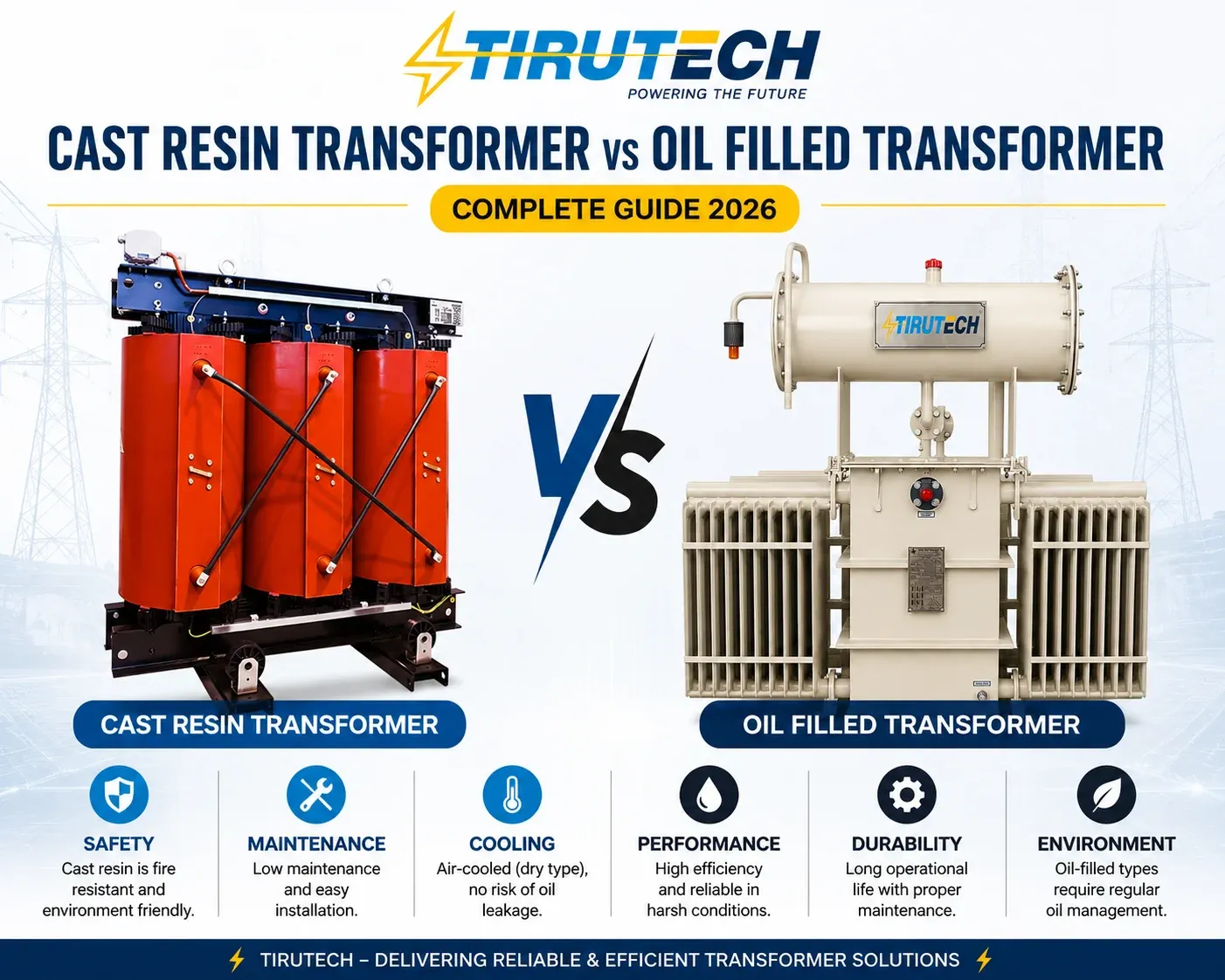
- Fire Safety — Clear Winner: Cast Resin
In any indoor environment — hospitals, metro stations, high-rise buildings — cast resin transformers are the safer choice. The epoxy resin encapsulation is self-extinguishing and does not support combustion. Oil filled transformers, if not properly maintained, pose a fire risk due to flammable mineral oil. For fire-sensitive locations, a cast resin transformer vs oil filled transformer comparison always favours the dry type.
- Maintenance — Cast Resin Requires Less
One of the biggest advantages of cast resin transformers is near-zero maintenance. There is no oil to test, filter, or replace. In contrast, oil filled transformers require periodic Dissolved Gas Analysis (DGA), oil filtration, and Buchholz relay testing. For facilities with limited maintenance staff, dry type is clearly superior in the cast resin transformer vs oil filled transformer debate.
- Cost — Oil Filled is More Affordable Initially
If budget is the primary concern, oil filled transformers have a lower initial purchase cost. However, when you factor in long-term maintenance, oil containment systems, and fire suppression systems, the total cost of ownership of a cast resin transformer is often comparable or lower over a 25-year lifespan.
- Environment & Location Suitability
Cast resin transformers are the go-to choice for polluted, humid, or coastal environments due to their sealed epoxy construction. Oil filled transformers are better suited for outdoor substations, rural electrification, and large grid applications where capacity is critical in the cast resin transformer vs oil filled transformer selection.
When to Choose Cast Resin Transformer?
Choose a cast resin transformer when:
- Installation is indoors — hospitals, malls, offices, metros
- Fire safety regulations are strict (IEC 60076-11)
- Environment is humid, coastal, or heavily polluted
- Capacity requirement is up to 20 MVA
- Solar power plants and renewable energy projects
- Data centres and IT parks where downtime is unacceptable
- Compact substations in urban areas
When to Choose Oil Filled Transformer?
Choose an oil filled transformer when:
- Outdoor installation in open yards or substations
- Large capacity requirement above 20 MVA
- Rural electrification and utility grid applications
- Budget is a primary constraint
- Industrial applications — steel plants, paper mills, cement plants
- Export projects to Africa, Middle East, Southeast Asia
Frequently Asked Questions (FAQ)
Q1: Which is more efficient — cast resin or oil filled transformer?
Both are highly efficient. Oil filled transformers have a marginal efficiency advantage (up to 99.5%) over cast resin transformers (up to 99%). For most industrial applications, this difference is negligible. In the cast resin transformer vs oil filled transformer efficiency debate, the gap is closing rapidly with newer epoxy resin technologies.
Q2: Can cast resin transformers be installed outdoors?
Standard cast resin transformers are designed for indoor use. However, with additional weatherproof enclosures (IP54 or IP65), they can be installed outdoors. Oil filled transformers remain the preferred outdoor option in the cast resin transformer vs oil filled transformer choice for outdoor substation projects.
Q3: What is the lifespan of cast resin vs oil filled transformer?
Cast resin transformers typically last 25-30 years with minimal maintenance. Oil filled transformers can last 25-35 years with proper oil maintenance. Both offer excellent long-term value in the cast resin transformer vs oil filled transformer comparison.
Q4: Are cast resin transformers BIS certified in India?
Yes. At Tirupati Transformers, our cast resin transformers are manufactured as per IEC 60076-11 and IS standards by BIS. All units are tested at our in-house facility before dispatch.
Conclusion — Making the Right Choice in 2026
The cast resin transformer vs oil filled transformer decision ultimately depends on your application, location, budget, and safety requirements. For indoor, fire-sensitive, and high-humidity environments, cast resin transformers are the clear choice. For large outdoor power distribution projects, oil filled transformers remain the industry standard.
At Tirupati Transformers Pvt. Ltd., we manufacture both types Cast Resin Transformer vs Oil Filled Transformer — ISO 9001:2015 certified, BIS approved, with delivery across India and exports to 20+ countries.
📞 Get a Free Quote → Contact Us