 Sushil Singh 18 June 2026
Transformer For Factory Greater Noida: What Size Do You Really Need? (2026 Guide)
Every factory owner asks this question sooner or later — usually right before a big purchase, or right after a transformer failure shuts down production for a day. And it’s a fair question, because the answer directly affects your electricity bill, your machine life, and your downtime.
Here’s the problem: most people guess. They either copy what a neighbouring factory installed, or they trust a salesperson who oversells them a bigger unit. Both mistakes are expensive.
At Tirupati Transformer, we’ve sized and installed transformers for manufacturing units across Greater Noida — from small fabrication workshops to large production plants. In this guide, we’ll walk you through exactly how to choose the right transformer for factory Greater Noida, using the same step-by-step method our engineers use on site. No jargon, no guesswork.
Why Getting the Transformer Size Right Actually Matters
A transformer isn’t a “bigger is safer” purchase. Both extremes cost you money:
Too small: It runs hot, trips often, ages faster, and one overload can halt your entire production line. Replacing a burnt-out transformer is far more expensive than sizing it right the first time.
Too large: You pay more upfront, and an oversized transformer wastes energy through no-load losses every hour it’s switched on — even when your machines are idle. Over 10 years, that’s lakhs of rupees quietly leaking from your account.
The sweet spot is a transformer matched to your real load, with a small margin for future growth. Get this right, and a well-sized transformer for factory Greater Noida can cut your energy losses by 10–15% over its lifetime.
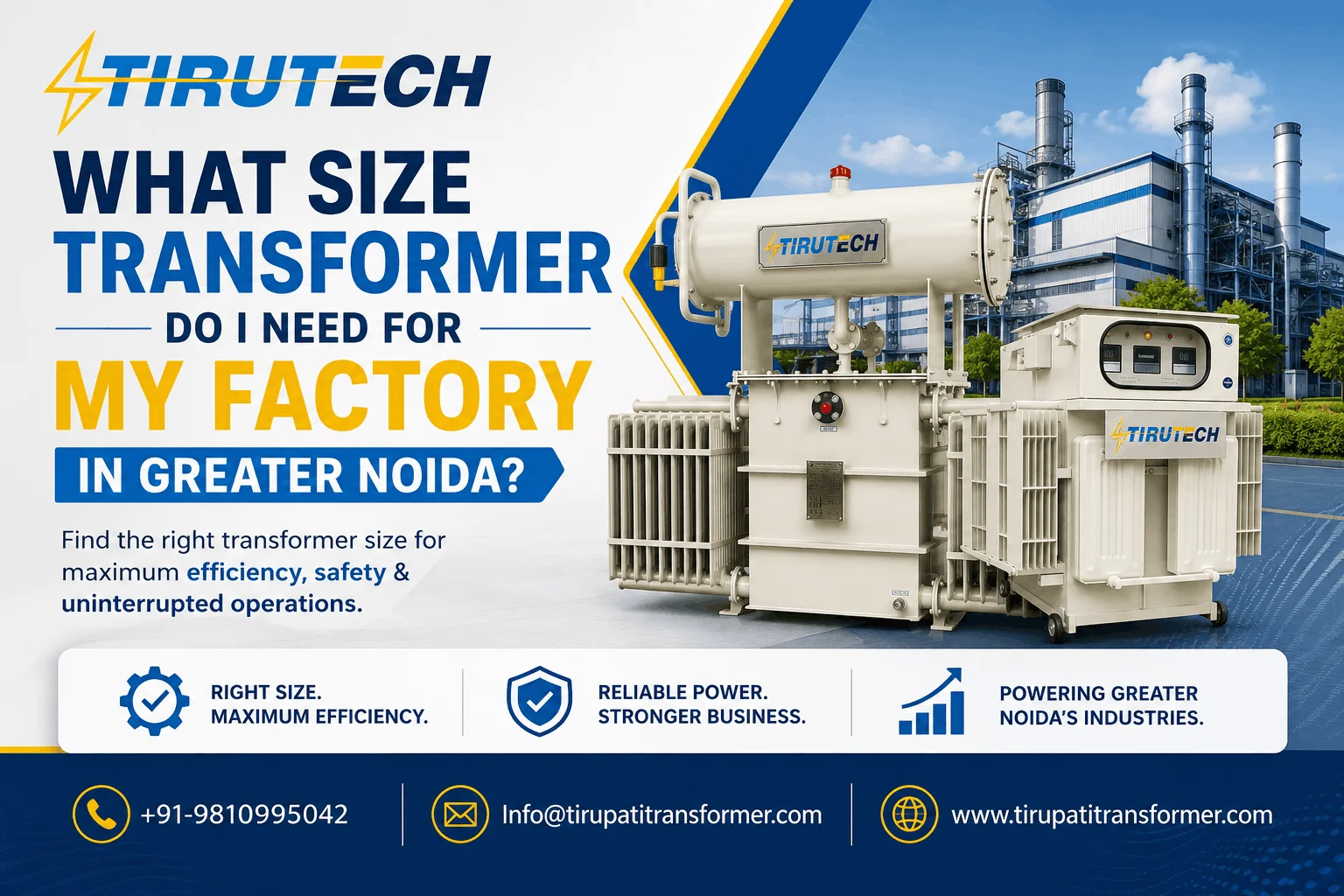
Step 1: Find Your Factory’s Total Power Load
You can’t size a transformer until you know how much power your factory actually draws. Don’t worry — you don’t need an engineering degree for this. Just follow three steps.
List Every Piece of Equipment
Walk through your factory and note down everything that uses power: motors, CNC machines, welding sets, compressors, lighting, HVAC, and office load. Write the power rating of each (you’ll find it in kW or HP on the nameplate).
Add It All Up
Convert everything to kilowatts (remember: 1 HP ≈ 0.746 kW) and total it. This figure is your connected load — the maximum power if every single device ran at once.
Apply a Realistic Demand Factor
In reality, your machines never all run together. So multiply your connected load by a demand factor (typically 0.6–0.8 for factories) to get your true maximum demand.
Example: Connected load = 150 kW. Demand factor = 0.7. → Maximum demand = 105 kW.
This single number is the foundation of correctly sizing any transformer for factory Greater Noida.
Step 2: Convert Your Load Into kVA
Transformers are rated in kVA, not kW — so you need one quick conversion. The transformer kVA calculation is simple:
kVA = kW ÷ Power Factor
Most Indian industrial setups run at a power factor of about 0.8. Using our example:
105 kW ÷ 0.8 = 131 kVA
Now add 20–25% headroom for future expansion — because no factory stays the same size forever. That brings us to roughly 160 kVA, which means a standard 160 kVA transformer is your ideal match.
For official efficiency norms, you can cross-check the Bureau of Energy Efficiency (BEE) standards.
Step 3: Single-Phase or Three-Phase?
For industrial use, this isn’t really a debate. A three-phase transformer is the correct choice for almost every factory — it powers heavy motors smoothly, balances load better, and is the standard across all industrial zones. Single-phase units only suit very small or residential setups.
So for any serious transformer for factory Greater Noida, go three-phase.
Step 4: Oil-Cooled vs Dry-Type — Which One Fits Your Setup?
This choice depends on where and how you’ll install the unit, not just the size.
| Factor | Oil-Cooled | Dry-Type |
|---|---|---|
| Best location | Outdoor / large capacity | Indoor / fire-sensitive areas |
| Upfront cost | Lower | Higher |
| Maintenance | Periodic oil testing | Low maintenance |
| Safety | Needs containment | Better for enclosed spaces |
If your factory has outdoor space, an oil-cooled transformer is the economical, time-tested option. If you’re installing indoors or near a fire-sensitive zone, a dry-type transformer is the safer pick. Not sure which suits your floor plan? Our team explains both in detail on our transformer products & services page.
What Makes Greater Noida Different (Local Factors to Check)
Sizing is only half the job. Local industrial conditions matter just as much when buying a transformer for factory Greater Noida:
Voltage fluctuations: Many industrial pockets in Greater Noida face supply instability. Choose a transformer with strong voltage regulation so your equipment stays protected.
BIS / ISI certification: Never compromise here. A BIS certified transformer guarantees the unit meets Indian safety and quality standards. Verify norms on the Bureau of Indian Standards (BIS).
Local service & delivery: A nearby manufacturer means faster installation, quicker repairs, and minimal downtime. This is where buying local genuinely pays off.
Energy efficiency: An energy efficient transformer costs a little more but saves significantly on running costs year after year.
Quick Transformer Size Reference
Use this as a starting point — but always confirm with an expert before purchasing.
| Factory Maximum Demand | Recommended Transformer |
|---|---|
| Up to 65 kW | 100 kVA |
| 65 – 105 kW | 160 kVA |
| 105 – 165 kW | 250 kVA |
| 165 – 330 kW | 500 kVA |
A Common Mistake We See in Greater Noida Factories
One pattern we notice constantly: factory owners size their transformer for today’s machines and forget about expansion. Six months later, they add a new production line — and suddenly the transformer is overloaded.
The fix is simple. Always size with a 20–25% future buffer built in. It costs slightly more now, but it saves you from a complete replacement later. This single piece of foresight is the difference between a smart purchase and an expensive one.
Frequently Asked Questions
What size transformer do I need for a small factory?
Most small factories require between 100 kVA and 250 kVA. The exact size depends on your total connected load and demand factor — always calculate your maximum demand first rather than guessing.
How do I calculate transformer capacity?
Total your load in kW, apply a demand factor (0.6–0.8), divide by your power factor (around 0.8) to get kVA, then add 20–25% for future growth. The best Transformer For Factory Greater Noida is one sized to your real load with a 20–25% buffer.
Which transformer is best for a factory in Greater Noida?
A three-phase, BIS certified transformer sized to your actual load with a small expansion margin. Whether you choose oil-cooled or dry-type depends on your installation space and fire-safety needs.
Is a bigger transformer always better?
No. An oversized transformer wastes energy through no-load losses and costs more upfront. Right-sizing is always better than over-sizing.
Get the Right Transformer With Tirupati Transformer
Sizing a transformer correctly takes the guesswork out of one of your factory’s biggest investments — but you don’t have to do it alone. At Tirupati Transformer, our engineers assess your actual load, recommend the precise kVA, and deliver a fully BIS-compliant unit with fast local installation and dependable after-sales support.
👉 Contact Tirupati Transformer today for a free load assessment and a no-obligation quote for your transformer for factory Greater Noida.