 Sushil Singh 19 August 2025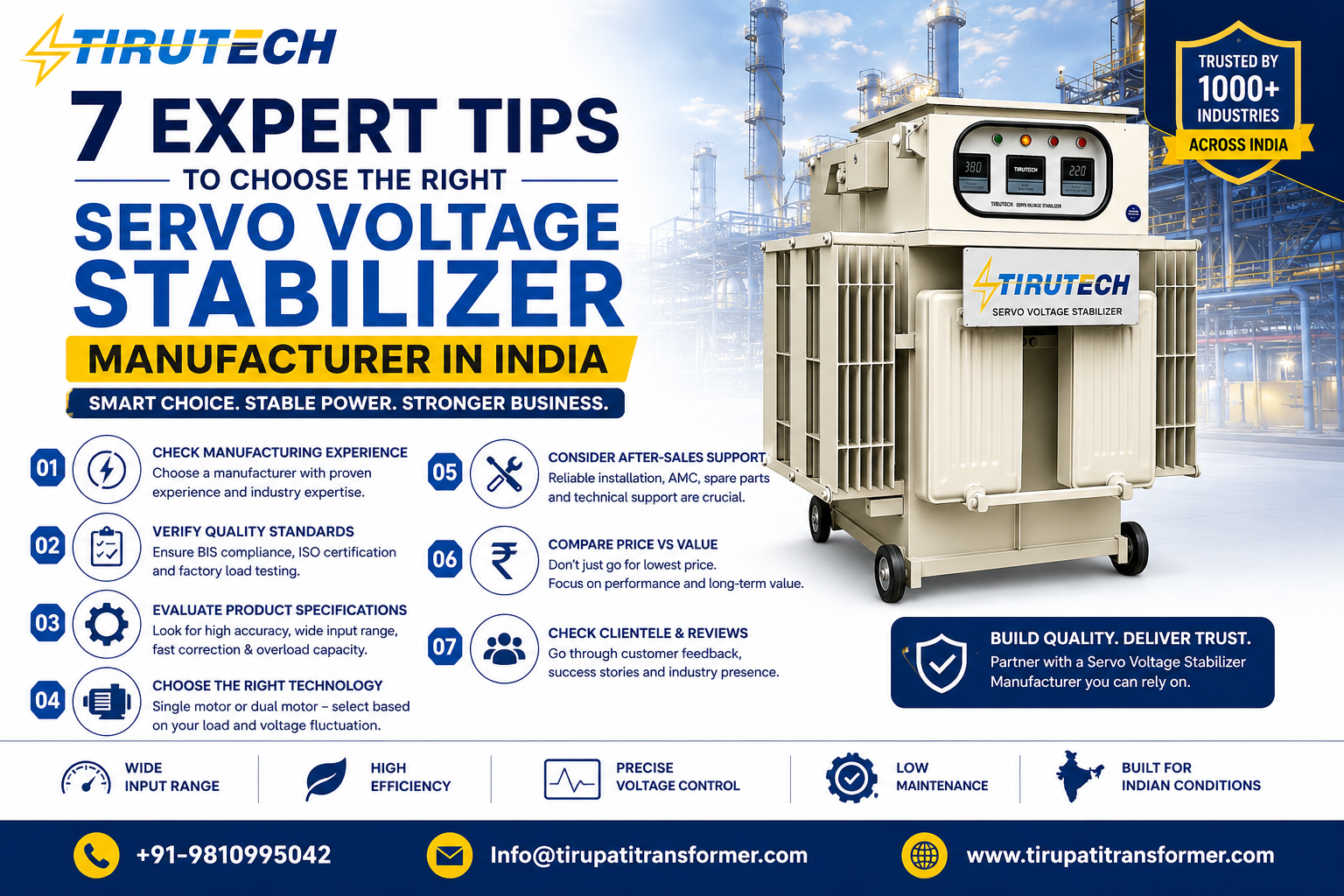
If you’re searching for the best Servo Voltage Stabilizer Manufacturer India, selecting the right manufacturer is just as important as selecting the right stabilizer capacity. A high-quality servo voltage stabilizer protects expensive electrical equipment from voltage fluctuations, improves operational efficiency, and increases equipment life.
At Tirupati Transformer, we have over 10+ years of manufacturing experience supplying industrial servo voltage stabilizers across India. This guide explains everything you should know before choosing a Servo Voltage Stabilizer Manufacturer India, including sizing, correction speed, installation requirements, and maintenance.
Who this is for: plant engineers, facility managers, and procurement teams choosing a servo voltage stabilizer manufacturer in India for an industrial or commercial site — not buyers who already know their exact spec and just need a datasheet (see our product page for that).
the right stabilizer size depends on load type, harmonic content, correction speed, and phase balance — not just connected kVA. A 200 kVA connected load with CNC machines or VFDs typically needs a 280–300 kVA stabilizer, not a 200 kVA one. Incorrect sizing is one of the most common reasons for poor performance and premature failure.
Why Voltage Fluctuation Is a Bigger Problem in India Than Most Buyers Realise
India’s industrial power supply rarely sits at a clean, constant voltage. Grid voltage in most industrial belts swings between 340V and 460V depending on the time of day, the load on the local feeder, and the season. For a facility running CNC machines, injection moulding equipment, or sensitive electronic assembly lines, this isn’t a minor inconvenience — it’s the difference between a machine lasting fifteen years and one failing in five.
A servo voltage stabilizer exists to correct exactly this problem: it continuously monitors incoming voltage and mechanically adjusts a variable transformer (via a servo motor) to hold output voltage within a tight band, typically ±1%, regardless of how much the input swings.
What Should You Look for in a Manufacturer?
four factors matter more than raw kVA — load type (linear vs non-linear), required correction speed, phase balance, and ambient site conditions. A manufacturer worth choosing will ask about all four before quoting a price, not just the kVA number.
Most buyers focus only on kVA rating, and that’s a mistake. Here’s what we walk through with every customer before recommending a unit:
- Load Type — Linear vs Non-Linear
Motors, heaters, and lighting are linear loads and are relatively forgiving. CNC machines, VFDs, UPS systems, and modern electronic equipment are non-linear loads that draw current in sharp pulses (harmonics). A stabilizer sized correctly for a linear load will often undersize badly for a harmonic-heavy load — the correction winding overheats faster than the nameplate rating suggests. We size for your actual load profile, not just the connected kVA.
- Correction Speed
A standard servo stabilizer corrects voltage at roughly 1V to 1.5V per second (using a single motor). For facilities with frequent, rapid dips — common near industrial areas with heavy motor-starting loads nearby — a dual-motor design corrects almost twice as fast, protecting equipment during the correction window itself rather than after the fact.
- Balanced vs Unbalanced Design
Three-phase industrial supply in India is frequently unbalanced by a few percent between phases, especially at the tail end of a feeder. A stabilizer built only for balanced input will correct the average and leave one phase still out of tolerance. Where phase imbalance is a known issue at your site, we build the correction circuit per-phase rather than as a single average control.
- Ambient Conditions
Foundries, plastic units, and textile mills often run stabilizers in high-ambient-temperature, dusty environments. Standard IP20 enclosures aren’t sufficient here — we specify IP42 or higher with additional cooling margin for these environments, which is a detail most standard catalogue units don’t account for.
How Do You Size a Stabilizer Correctly?
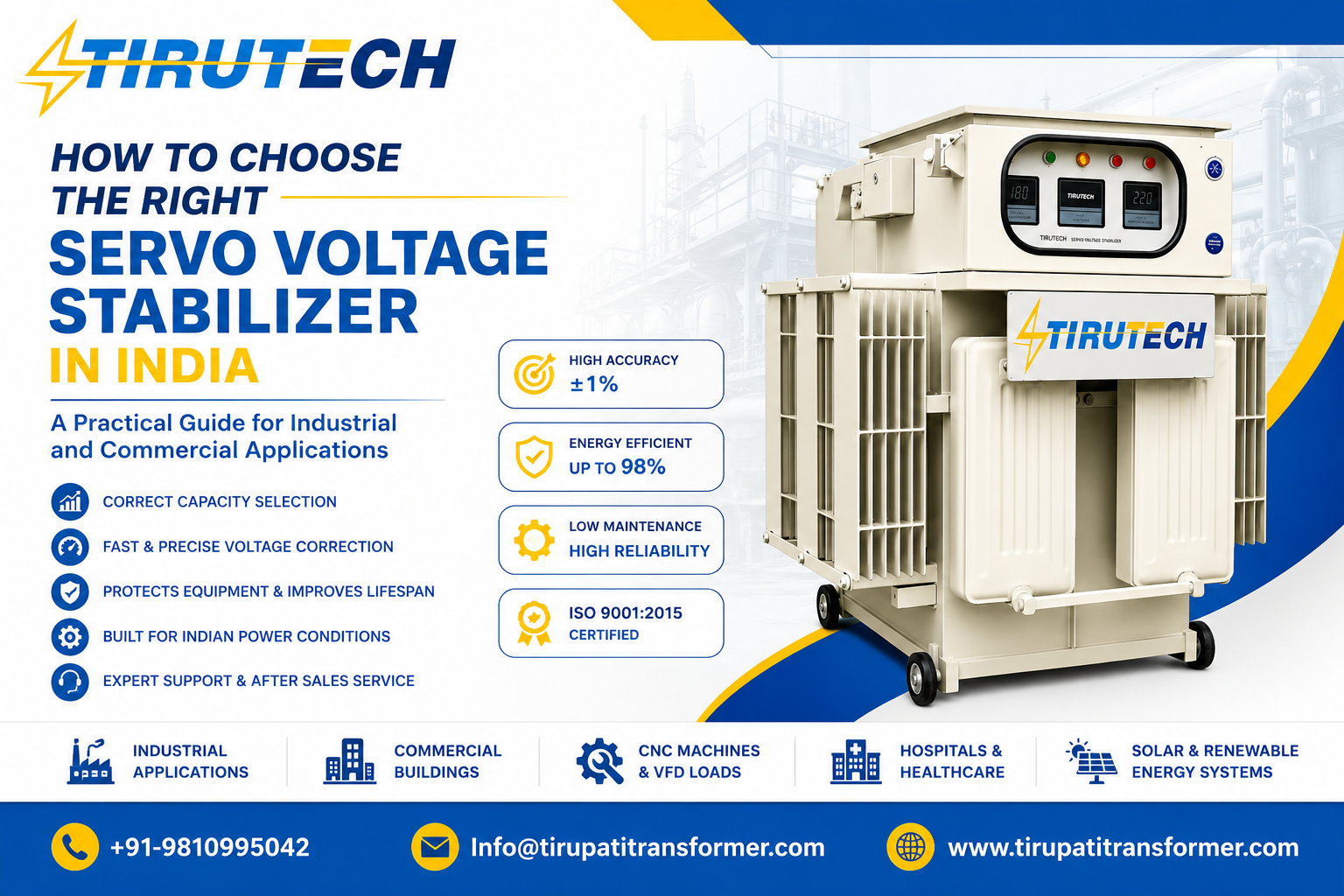
Calculate connected load in kVA, identify what share of it is non-linear, then add 20–25% headroom for non-linear loads (15% for linear loads) — rather than using connected kVA directly.
Rather than a generic formula, here’s the process we actually use:
List the connected load in kVA (not kW — power factor matters)
Identify what percentage of that load is non-linear (VFDs, CNC, electronics)
Add 20–25% headroom for non-linear loads, 15% for linear loads
Check your actual site voltage range over a representative week if possible — sites with wider swings need higher correction range, not just higher kVA
Practical Example
| Connected Load | Non-Linear Share | Recommended Stabilizer |
|---|---|---|
| 100 kVA | Low | 115–120 kVA |
| 200 kVA | 40% | 280–300 kVA |
| 500 kVA | Heavy VFD load | Engineering assessment recommended |
Incorrect sizing remains one of the most common issues encountered during replacement projects.
What Installation Details Get Missed Most Often?
Incoming cable sizing, neutral bonding on 4-wire systems, and ventilation clearance around the unit — all three are frequently overlooked and cause problems that get blamed on the stabilizer itself.
Cable sizing matters as much as the unit itself — undersized incoming cable causes voltage drop that the stabilizer then has to “correct” for a problem that isn’t actually inside it
Neutral bonding must be checked at the site, particularly for 4-wire systems feeding mixed single and three-phase loads
Ventilation clearance — servo stabilizers reject heat through top-mounted fans; installations in enclosed electrical rooms without adequate air exchange run hotter than the rated ambient assumes
How Much Maintenance Does a Servo Stabilizer Need?
Carbon brush inspection every 6 months, contact cleaning annually, and a servo motor bearing check at 3 years — because a servo stabilizer has moving parts, unlike a static (relay-based) unit.
A servo stabilizer’s moving parts — carbon brushes, servo motor, and the variable transformer’s wiper contact — are mechanical and do wear. Sites running 24-hour continuous operation should plan for:
| Maintenance Activity | Frequency |
|---|---|
| Carbon brush inspection | Every 6 months |
| Contact cleaning | Every 12 months |
| Servo motor inspection | Every 3 years |
| Electrical tightness check | Annually |
| Thermal inspection | During AMC visit |
This is different from a static (relay-based) stabilizer, which has no moving parts but corrects in discrete steps rather than smoothly — a trade-off worth discussing based on how sensitive your equipment actually is to step changes.
Servo vs Static Stabilizer
| Feature | Servo Stabilizer | Static Stabilizer |
|---|---|---|
| Voltage correction | Smooth & continuous | Step-wise |
| Moving parts | Yes | No |
| Maintenance | Periodic | Minimal |
| Accuracy | High | High |
| Best for | Sensitive industrial equipment | Fast electronic applications |
Benefits of Choosing a Trusted Servo Voltage Stabilizer Manufacturer India
Top 10 Benefits of Servo Voltage Stabilizers for Homes and Industries. Working with an experienced manufacturer provides several advantages.
- Accurate Capacity Selection
- Customized Design
- Better Voltage Regulation
- Lower Maintenance Cost
- Longer Equipment Life
- High Efficiency
- Copper Winding Construction
- Reliable Technical Support
- Factory Testing
- Nationwide Delivery
Why Choose Tirupati Transformer
We manufacture servo voltage stabilizers from 100 kVA to 5000 kVA at our Greater Noida facility, built to IS 9815 (the Bureau of Indian Standards specification for AC automatic voltage stabilizers) and IEC 60076 transformer testing standards, with both single-motor and dual-motor correction designs depending on your site’s correction-speed requirement. Every unit is tested on our factory floor against actual load-simulation profiles, not just no-load parameters, before dispatch.
A few things that set Our Strengths
- 10+ Years Manufacturing Experience
- ISO 9001:2015 Certified
- BIS-Compliant Products
- Copper Winding Construction
- Factory Load Testing
- Single & Dual Motor Designs
- Custom Voltage Solutions
- Pan India Delivery
- Competitive Factory Pricing
- Experienced Engineering Team
Every stabilizer is tested under actual operating conditions before dispatch.
Who Should Buy Our Servo Voltage Stabilizers?
Our products are suitable for:
- Manufacturing Industries
- Hospitals
- Data Centers
- Pharmaceutical Plants
- Hotels
- Commercial Buildings
- Solar Power Plants
- Educational Institutions
- Warehouses
- Food Processing Industries
- Infrastructure Projects
If you’d like help sizing a stabilizer against your load profile rather than a generic kVA number, share your connected load list and we’ll work through the calculation with you.
Related: Full product specifications and technical datasheet
Frequently Asked Questions
What is a servo voltage stabilizer used for?
It automatically corrects fluctuating incoming electrical supply to a steady output voltage, protecting industrial and commercial equipment from damage caused by voltage swings, sags, and surges.
What’s the difference between this guide and your product page?
This page helps you work out which specification you need and why. The product page has the full technical datasheet, dimensions, and ordering specifications once you know what you’re looking for.
Can an undersized stabilizer damage my equipment?
Yes — an undersized unit under non-linear load runs its correction winding at sustained high temperature, shortening the stabilizer’s own life and, in some failure modes, allowing voltage excursions through before internal protection trips.
How long does installation and commissioning take in India?
For units up to 200 kVA, factory-to-commissioning is typically 3–4 weeks including site survey. Larger custom units run 6–8 weeks.
Should I choose a servo stabilizer or a static (relay-based) stabilizer?
Choose a servo stabilizer when your equipment is sensitive to voltage variation and needs smooth, continuous correction. Choose a static stabilizer when correction speed matters more than smoothness and you want zero moving parts to maintain.
Do you provide AMC (Annual Maintenance Contracts) in India?
Yes, covering brush inspection, contact cleaning, and thermal checks — see our Services page for full AMC scope and pricing.
Contact Tirupati Transformer
If you’re looking for a reliable Servo Voltage Stabilizer Manufacturer India, our engineering team can help you choose the right solution for your application.
📞 Phone: +91-9810995042
📧 Email: Info@tirupatitransformer.com
🌐 Website: www.tirupatitransformer.com