 Sushil Singh 18 September 2025
Different Types of Transformer: Which One is Right for You?
Choosing the right Different Types of Transformer can be confusing — step-up, step-down, dry type, power transformer… so many options. This guide breaks down every major type of transformer in simple terms so you can make the right decision for your home, business, or industrial project.
At Tirupati Transformers, we have been manufacturing and supplying high-quality Different Types of Transformer across India since 2014. Whether you need a small distribution transformer or a large power transformer, we have the right solution for you.
What is a Transformer?
A Different Types of Transformer is a static electrical device that transfers electrical energy between two circuits using electromagnetic induction. Its primary job is to either increase (step up) or decrease (step down) voltage levels — safely and efficiently.
Every Different Types of Transformer has three core components: the Primary Winding (input side), the Magnetic Core (silicon steel laminations), and the Secondary Winding (output side). The ratio of turns between these two windings determines how much the voltage changes.
Different Types of Transformer Explained
Different Types of Transformer are classified based on their function, voltage level, cooling method, and application. Here are the most important types used across India.
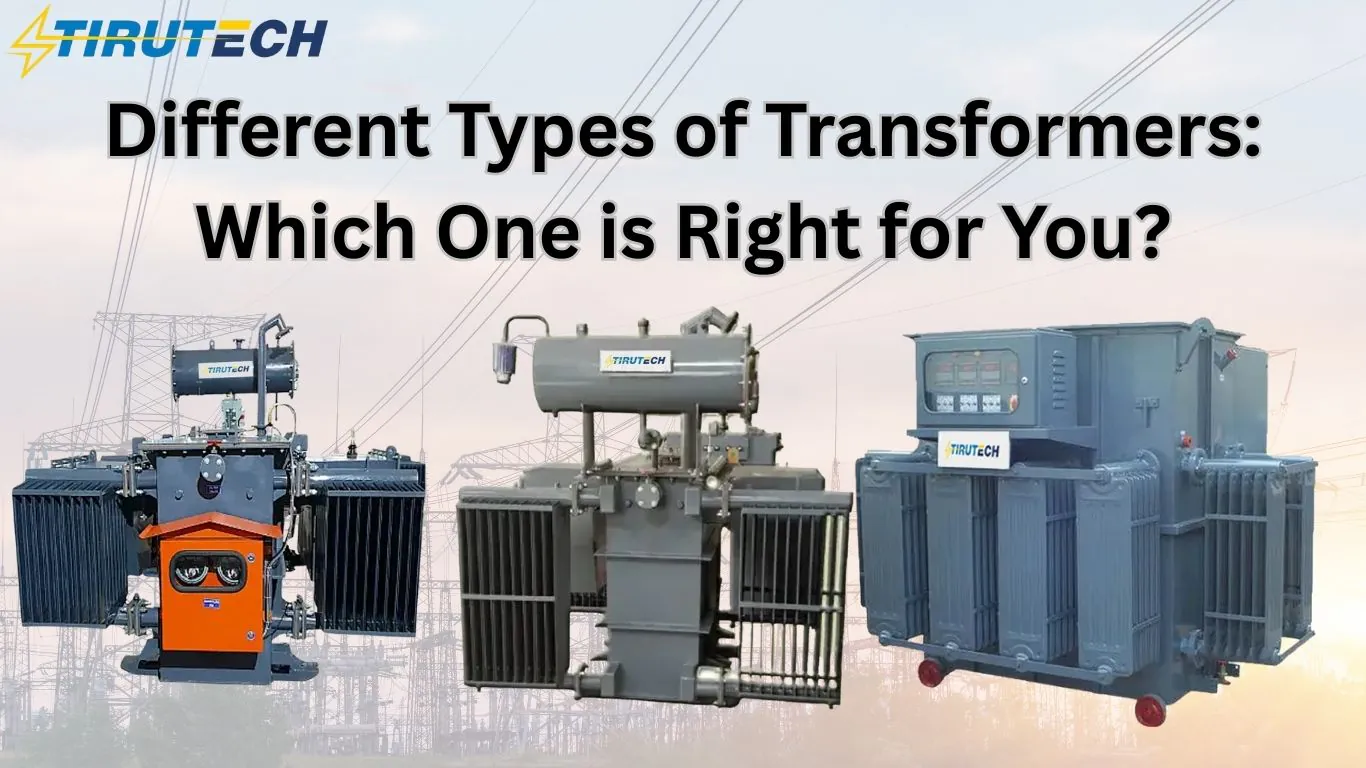
Step-Up Transformer — For Long-Distance Power Transmission
A step-up transformer increases the output voltage above the input voltage. It has more turns on the secondary winding than the primary.
Power plants generate electricity at relatively low voltage. To send this power hundreds of kilometres through transmission lines without major energy loss, the voltage must be boosted to 132 kV or higher. That is exactly what a step-up transformer does.
Best for: Power generation stations, grid substations, solar and wind energy farms, industrial transmission networks.
Step-Down Transformer — For Safe Voltage Delivery
A step-down transformer reduces high input voltage to a lower, safer output voltage. It has more turns on the primary winding than the secondary.
High-voltage electricity from transmission lines cannot be used directly in homes or offices. A step-down transformer brings it down to 415V or 230V — which is safe for everyday use.
Best for: Residential areas, offices, commercial buildings, schools, hospitals, and small factories.
Distribution Transformer — The Last Mile of Power Delivery
A distribution transformer is a specialised step-down transformer that handles the final stage of power delivery — from the substation to your door. It converts 11 kV or 33 kV from the grid down to 415V/230V for homes and businesses.
These Different Types of Transformer use an oil-immersed design where Different Types of Transformer oil acts as both a coolant and insulator. They are the most commonly seen Different Types of Transformer — mounted on poles or inside substations in your locality.
Key specs: 100 kVA to 5000 kVA capacity, IS 1180 and IEC 60076 compliant.
Best for: Residential colonies, rural electrification, commercial complexes, industrial estates.
Power Transformer — For Heavy Industrial Use
Power transformers are built for bulk power transmission at very high voltages. They operate at power stations and EHV grid substations where massive amounts of electricity are handled continuously.
| Feature | Power Transformer | Distribution Transformer |
| Capacity | 5 MVA to 10 MVA+ | 100 kVA to 5000 kVA |
| Voltage Level | 33 kV to 400 kV | Up to 33 kV |
| Location | Power stations, Grid | Near end consumers |
| Peak Efficiency | At full load | At 60–70% load |
Best for: Power plants, EHV substations, steel mills, cement plants, mining, data centres.
Tirupati Transformers manufactures power transformers up to 10 MVA and 66 kV, with both OCTC and OLTC tap changer options.
Dry Type Transformer — Safe for Indoor Installations
A dry type transformer uses air for cooling instead of oil. The windings are either open-wound or encased in solid epoxy resin — making it fire-safe, low-maintenance, and environment-friendly.
Why choose dry type?
No oil = no fire hazard
Safe for indoor and enclosed spaces
No oil testing or refilling required
Zero risk of oil spills or contamination
Ideal where environmental compliance matters
Best for: Hospitals, metro stations, airports, IT parks, data centres, multi-storey buildings, chemical plants.
Isolation Transformer — For Sensitive Equipment Protection
An isolation transformer electrically separates the input and output circuits completely. It has a 1:1 turns ratio — voltage stays the same but the circuits are fully isolated from each other.
This protects sensitive equipment from power surges, voltage spikes, electrical noise, and ground faults — which can damage or destroy expensive electronics.
Best for: ICUs and operation theatres, laboratories, CNC machines, industrial robots, audio systems, servers and IT infrastructure.
Auto Transformer — Compact and Cost-Effective
An auto transformer uses a single shared winding for both input and output, rather than two separate windings. This makes it smaller, lighter, and cheaper — but it works best when only a small voltage change (10–20%) is needed.
Best for: Motor starting, voltage regulation, HVAC systems, laboratory power supplies.
Solar Inverter Transformer — For Renewable Energy Projects
A solar inverter transformer is purpose-built for solar energy systems. It converts the AC output from a solar inverter into grid-compatible voltage, allowing solar power to feed safely into the grid or local distribution network.
With India’s solar sector booming — driven by PM Surya Ghar Muft Bijli Yojana and large-scale solar park projects — solar transformer demand is at an all-time high in 2025.
Best for: Rooftop solar installations, utility-scale solar farms, solar pumping stations, grid-tied solar projects.
Which Transformer is Right for You?
Here is a quick decision guide:
| Your Situation | Right Transformer |
| Sending power over long distances | Step-Up Transformer |
| Supplying power to homes/offices | Step-Down / Distribution Transformer |
| Large industrial or grid application | Power Transformer |
| Indoor installation, safety-critical area | Dry Type Transformer |
| Protecting medical or electronic equipment | Isolation Transformer |
| Solar or renewable energy project | Solar Inverter Transformer |
| Minor voltage adjustment needed | Auto Transformer |
Still not sure? Our engineering team at Tirupati Transformers will analyse your exact requirements and recommend the best transformer — free of charge. Contact Us for Expert Advice
Why Choose Tirupati Transformers?
Tirupati Transformer Pvt. Ltd. has been manufacturing Different Types of Transformer from Noida, Delhi NCR since 2014 — serving industries, utilities, and commercial projects across India.
ISO 9001:2015 certified
IS, IEC, and IEC 60076 compliant
Copper windings for maximum efficiency
Capacity up to 10 MVA and 66 kV
Custom transformer solutions available
Reliable after-sales service and support
Frequently Asked Questions
Q1. What are the different types of transformers?
The main types are step-up, step-down, distribution, power, dry type, isolation, auto transformer, and solar inverter transformer. Specialised types include furnace transformers, converter duty transformers, and instrument Different Types of Transformer.
Q2. Which transformer is used in homes?
A distribution transformer is used in residential areas. It steps down 11 kV to 230V/415V and is usually mounted on a pole or in a local substation.
Q3. What is the difference between a dry type and oil type transformer?
Dry type uses air cooling — safe for indoors, no fire risk, low maintenance. Oil type uses mineral oil — better for high-capacity outdoor use. Dry type costs more upfront but saves on long-term maintenance.
Q4. Which transformer is best for a solar project?
A solar inverter transformer is specifically designed for solar energy systems. Specifications vary based on system size — Tirupati Transformers offers custom solutions for both rooftop and utility-scale solar.
Q5. How do I get a quote for a custom transformer?
Share your voltage requirements, kVA capacity, application type, and installation location. Our team will send you a technical specification and quotation within 24–48 hours. Send an Enquiry